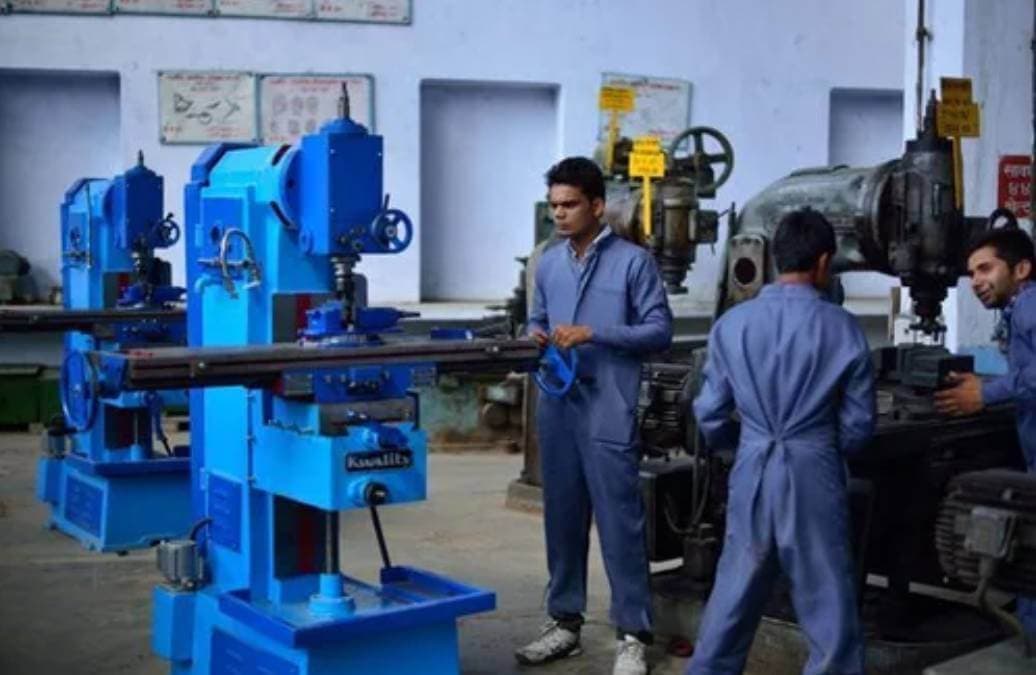
What the workforce looks like in this sector
Manufacturing requirements tend to be steadier than project work: repeatable production welding and fabrication, planned mechanical maintenance, and the materials handling and store roles that keep a line running. They are also more sensitive to fit. A worker joins an existing shift pattern, an existing quality system and an existing team, so the requirement is less about a large headcount on day one and more about the right few people who stay long enough to learn the plant.
Production welding is a different request from site welding
Shop work rewards consistency and deposition rate rather than position versatility, which is why MIG sits separately on the register from 6G. If the scope is repeat production rather than field joints, say so, because it changes who is the right match. Name the process, the material and thickness range and whether the shop tests welders to its own procedure before they start on production.
Maintenance windows are shorter but more frequent
Unlike a refinery turnaround, plant maintenance tends to run as many short planned stops. That favours a smaller standing crew that already knows the equipment over a large mobilization each time, and it is worth saying in the requirement whether you want continuity or a one-off. A crew that returns for each stop builds up knowledge of your machines that a new crew has to relearn.
The support roles are what keep the line moving
Forklift operators, storekeepers and drivers rarely appear in a requirement written by an engineer, and are usually the first thing missed when a supplied crew turns out to be slower than expected. If fabricators are waiting for material to be issued and moved, adding one forklift operator or storekeeper often does more for output than adding another welder.
Fabrication shops run on drawings and cut lists
Steel, pipe and duct fabrication each work from their own drawings: shop drawings and cut lists for structures, isometrics for pipe spools, and duct layouts for HVAC. The fabricator who reads one well is not automatically fluent in the others. Say which kind of fabrication the shop does, the typical product and the tolerances it works to, so the fabricators put forward match the work on the benches.
Panel and control work needs the right electrician
Wiring control panels and motor control centres is a different skill from building wiring or field cable work. It needs someone who works to schematics, labels and terminates to the drawing and tests before power-up. The register lists panel board electricians separately from general and industrial electricians. Name the panel types and the testing your quality system expects.
Shift patterns and continuity
Factories often run two or three shifts, including nights and weekends. Supplied workers join that pattern, which affects transport, accommodation and supervision. State the shift pattern, the expected length of the requirement and whether the same workers should return for later stops or campaigns. Accommodation and transport are quoted on request.
MODON industrial cities
Most factories outside Jubail and Yanbu sit in the industrial cities of MODON, which runs several each in Riyadh, Dammam and Jeddah. In Dammam's Second Industrial City it has added ready-built factories for light industry: food, medical, pharmaceutical and electrical. Smaller plants like these need short maintenance crews and shop trades more often than large shutdown teams.
Site access in Manufacturing
- Industrial city and factory gate
- Factories in MODON industrial cities and in the Royal Commission cities of Jubail and Yanbu control entry at their own gate, on top of the city's rules. Send approved names and documents early so passes are ready.
- Factory induction and PPE
- Each factory runs its own induction, PPE and housekeeping rules. Gulf Orbit's safety induction is completed before deployment, and the factory's own requirements are confirmed per site.
- Clean and controlled areas
- Food, pharmaceutical and electronics plants add hygiene and clean-area rules that affect clothing, medical checks and where a worker may go. List these in the RFQ so they are planned before arrival.
- Forklift and crane cards
- Forklift operators and crane operators carry TUV cards where the site requires them. State whether the factory also expects a machine-specific familiarisation before operation.
- Welder tests
- Welders qualify by a procedure test (WPQ) to your welding procedure, not a TUV card. Many shops run their own test on arrival; say so and the first day can be planned around it.
These are common sector practices, not legal requirements; what your site needs is confirmed per request.
Mobilization and RFQ response
In this sector, Gulf Orbit workers have been deployed through contractors on the King Salman International Complex for Maritime Industries and Services. Project experience
- RFQ response:
- within 24 hours of a complete RFQ
- Mobilization:
- 48–72 hours from PO for in-Kingdom personnel, subject to worker documents and site approvals what can delay it
- Worker cards:
- TUV or Aramco card copies sent with CVs where the trade holds one
- Safety induction:
- completed by every worker before deployment; record kept
- Offices:
- Dammam (head office), Jubail Industrial City, Al Khobar
- Accommodation and transport:
- quoted on request