
Pipe Fitter vs Pipe Fabricator: Which Trade Your Scope Actually Needs
The two piping trades Saudi contractors most often confuse when raising a manpower request — what each one actually does, where the work happens, and how to specify the right one.
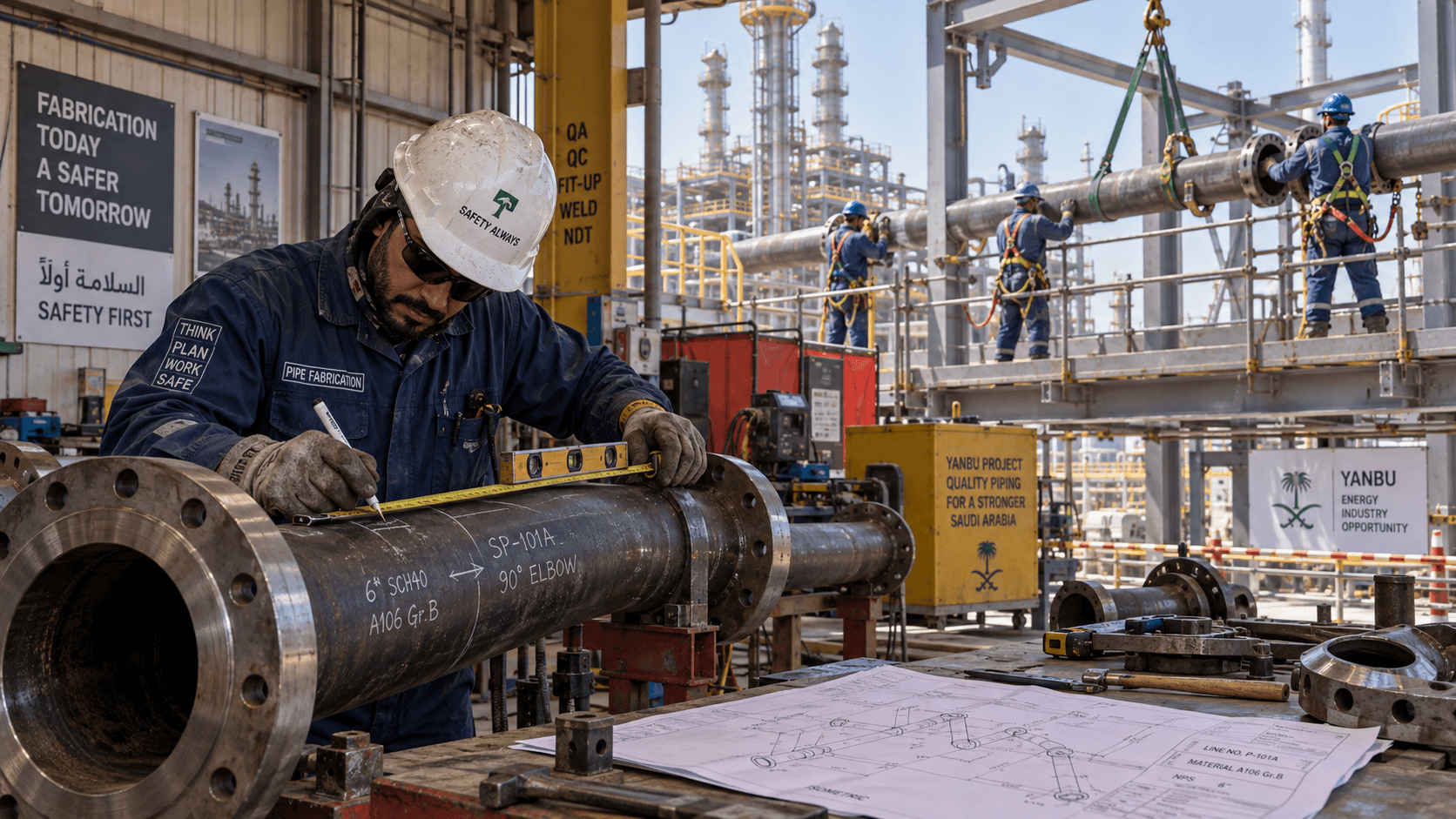
A pipe fabricator builds pipe spools from raw pipe in a shop or fabrication yard, working to isometric drawings. A pipe fitter installs those finished spools in position on site — aligning, supporting and bolting them into the plant. Same material, different work, different location and different skills: requesting the wrong one is one of the most common reasons a piping crew arrives and cannot start.
Key takeaways
- The fabricator produces the spool; the fitter installs it. That single distinction decides where the crew works and what they need around them.
- A fab shop crew needs cutting, bevelling and dimensional control. A site crew needs rigging access, permits and an available work front.
- Neither trade is a welder. Both prepare joints for a welder — budget the welder separately unless you specifically request a combined fitter-welder.
- Get the split wrong and the symptom is the same either way: a crew standing idle because the work they were sent to do is not the work that exists.
The short answer, and why the confusion is expensive
Both trades work with the same material, read the same drawings, and are often described loosely on site as "piping guys". The difference is where the work happens and what it produces.
A pipe fabricator works in a shop or fabrication yard. They take raw pipe lengths, fittings and flanges and turn them into finished spools — pre-assembled sections built to an isometric drawing, ready to be transported and lifted into place. Their work is measured, repeatable and under cover.
A pipe fitter works on site. They receive those spools, rig them into position, align them against existing steelwork and equipment, set supports, and bolt up flanges. Their work is congested, weather-exposed, permit-controlled, and full of things that are not quite where the drawing says they are.
The cost of getting this wrong is not subtle. Request fitters when your scope is spool production and you get a crew with no shop discipline standing in a fabrication yard. Request fabricators when your scope is site installation and you get a crew that is precise on a bench but slow working at height in a congested pipe rack. Either way you pay for the mobilisation, the accommodation and the idle days before anyone admits the mismatch.
What a pipe fabricator actually does
Fabrication is production work. The fabricator reads an isometric drawing, marks and cuts pipe to length, prepares the weld bevel, and fits the components — elbows, tees, reducers, flanges — into the correct orientation and dimension before a welder makes the joint permanent.
The skill is dimensional. A spool that is a few millimetres long, or a flange bolt-hole pattern rotated half a bolt, is a spool that will not go in on site — and the person who discovers that is a fitter on a scaffold, weeks later, with a crane on standby.
Good fabricators are also the trade that catches drawing errors before they become site problems, because they are the first people to build the thing physically rather than read it.
- Reads isometric and general arrangement drawings and marks pipe accordingly
- Cuts pipe to length and prepares weld bevels to the required angle
- Fits elbows, tees, reducers and flanges to correct orientation, dimension and bolt-hole alignment
- Tacks the assembly and presents fit-up for the welder and for QA inspection
- Maintains dimensional control against the isometric and flags drawing conflicts before release
- Marks, records and prepares finished spools for transport to site
What a pipe fitter actually does
Installation is site work, and site work is a negotiation with reality. The fitter receives spools, checks them against the drawing and the actual condition of the plant, rigs them into position, and gets them aligned and secured.
The skill here is spatial and practical rather than purely dimensional. Existing pipework is rarely exactly where the model says. Steelwork has been modified. A support has been moved to clear a cable tray. The fitter is the trade that makes the designed configuration meet the built one — deciding what can be adjusted, what needs a field weld, and what has to go back to engineering.
On a shutdown, fitters also handle tie-ins to existing systems, where scheduling, permits and isolation confirmations matter as much as the fitting work itself.
- Receives and verifies spools against isometrics and site conditions
- Rigs and positions spools, usually working with a rigger and lifting equipment
- Aligns pipe runs, sets gradients and holds tolerances against existing plant
- Installs and adjusts pipe supports, hangers, shoes and guides
- Bolts up flanges to the specified torque, fits gaskets and prepares joints for the welder
- Executes tie-ins to existing systems under permit during shutdown windows
Side by side
The fastest way to work out which trade a scope needs is to ask where the work physically happens and what leaves at the end of the shift.
| Pipe fabricator | Pipe fitter | |
|---|---|---|
| Where the work happens | Fabrication shop or yard, under cover | On site — at height, in racks, inside the plant |
| What it produces | Finished spools ready for transport | Installed, aligned, supported pipe runs |
| Works from | Isometric drawings, cut lists, spool registers | Isometrics plus the actual site condition |
| Core skill | Dimensional accuracy and fit-up quality | Alignment, spatial problem-solving, working around existing plant |
| Usually works with | Welders, QA and dimensional control, material store | Riggers, crane operators, scaffolders, welders, permit holders |
| Typical constraint | Shop throughput and material availability | Work-front availability, access, permits and isolations |
| Judged on | Spools that fit first time on site | Joints aligned to tolerance and handed over on schedule |
| Ask for them when | You are producing spools ahead of installation | You are installing, modifying or tying in on site |
How the two connect on a real project
On most piping packages the two trades are sequential, and the handover between them is where schedules are won or lost.
Fabrication runs ahead of installation. Spools are produced, inspected and released to site in packages matched to work fronts. If the shop falls behind, site fitters run out of material and the installation crew idles. If the shop runs ahead but site access is not ready — scaffolding not up, isolation not granted, a work front still occupied by another trade — then finished spools stack up in the laydown area and the money is sitting on the ground.
This is why piping manpower is planned as a sequence rather than two separate requests. A common planning error is to mobilise both crews at full strength on day one. In practice the fabrication crew ramps first, the installation crew follows once the first spool packages are released, and the two taper at different points.
It is also why scaffolding manpower sits upstream of the fitters: no access, no installation, regardless of how many spools are ready.
Which one does your scope need?
Work through these. If you answer yes to most in one direction, that is your trade — and if you answer yes to both, you need a planned split rather than a single headcount.
- Are spools being produced for this scope, or supplied already fabricated by others? Producing them yourself means fabricators.
- Is the work happening in a shop or yard, or inside the plant? Shop means fabricator; plant means fitter.
- Does the scope involve tie-ins to existing systems? That is fitter work, under permit.
- Is there a crane, rigger or scaffold requirement attached? That points to site installation, so fitters.
- Is the deliverable a set of spools, or a pressure-tested installed system? The deliverable names the trade.
- Is there a fabrication drawing release schedule? If so, fabricator demand is driven by it and fitter demand follows it.
How to write the request so you get the right crew
Most mismatched piping requests are not caused by a supplier sending the wrong people. They are caused by a request that says "20 pipe fitters" when the scope is spool production, and nobody catches it until mobilisation.
Name the trade explicitly, then give the three things that let a supplier sanity-check it: where the work is, what the deliverable is, and what the piping is made of. Material matters more than most requests acknowledge — carbon steel, stainless and alloy work are not interchangeable in terms of who should be sent.
If your scope genuinely needs both, say so and give the split and the sequence. A request for "12 fabricators from week 1, 16 fitters from week 4" can be planned properly. A request for "28 piping manpower" cannot.
You can see what each trade covers on the pipe fabricator and pipe fitter pages, and send the scope through the manpower request form when you are ready for a quotation.
- The trade, named — pipe fabricator, pipe fitter, or a stated split of both
- Where the work happens — shop, fabrication yard, or a named site and unit
- Pipe material and size range — carbon steel, stainless, alloy; small bore or large bore
- Whether welders are included in the request or sourced separately
- Whether the scope includes tie-ins, and if so the shutdown window
- Headcount by phase rather than a single number, with start date and expected duration
FAQ
Can one person do both jobs?
On small scopes, often yes — an experienced piping tradesman can fabricate and install. At volume the two specialise, because the skills diverge: shop work rewards dimensional precision and repeatability, site work rewards spatial problem-solving and working safely around existing plant. If you need someone who genuinely does both, say so in the request rather than assuming it, because it changes who is selected.
Do pipe fitters and pipe fabricators weld?
Usually not. Both trades prepare joints — cutting, bevelling, aligning and tacking — and a welder makes the joint permanent. Combined fitter-welder roles do exist, but they should be requested explicitly and are priced differently. If your request does not mention welders, budget for them separately or you will be short on the critical path. Gulf Orbit supplies welders under welder supply, including 6G and TIG.
Which trade do I need for a shutdown tie-in?
Pipe fitters, working under permit, supported by welders and usually by riggers and scaffolders. A fabricator is only needed during a shutdown if spools are being produced or modified inside the window — which does happen when a discovery scope appears mid-turnaround. Tie-in work is heavily permit- and isolation-dependent, so the constraint is rarely headcount alone. See shutdown and turnaround manpower.
What ratio of fabricators to fitters should I plan?
There is no universal ratio — it depends on spool complexity, how much is pre-fabricated by others, site access, and how the drawing release is phased. The useful discipline is to plan them as a sequence rather than a single mobilisation: fabrication ramps first, installation follows the first released spool packages, and the two taper at different points. Share your drawing release schedule and work-front availability and the ratio follows from it.
Does Gulf Orbit supply both trades?
Yes. Both pipe fabricators and pipe fitters are in Gulf Orbit's documented trade register, alongside the welders, riggers and scaffolders that piping scopes usually need around them. Requests can be made for either trade individually or as a phased split. Send the scope, material and programme through the manpower request form and it will be reviewed against what the site actually needs.