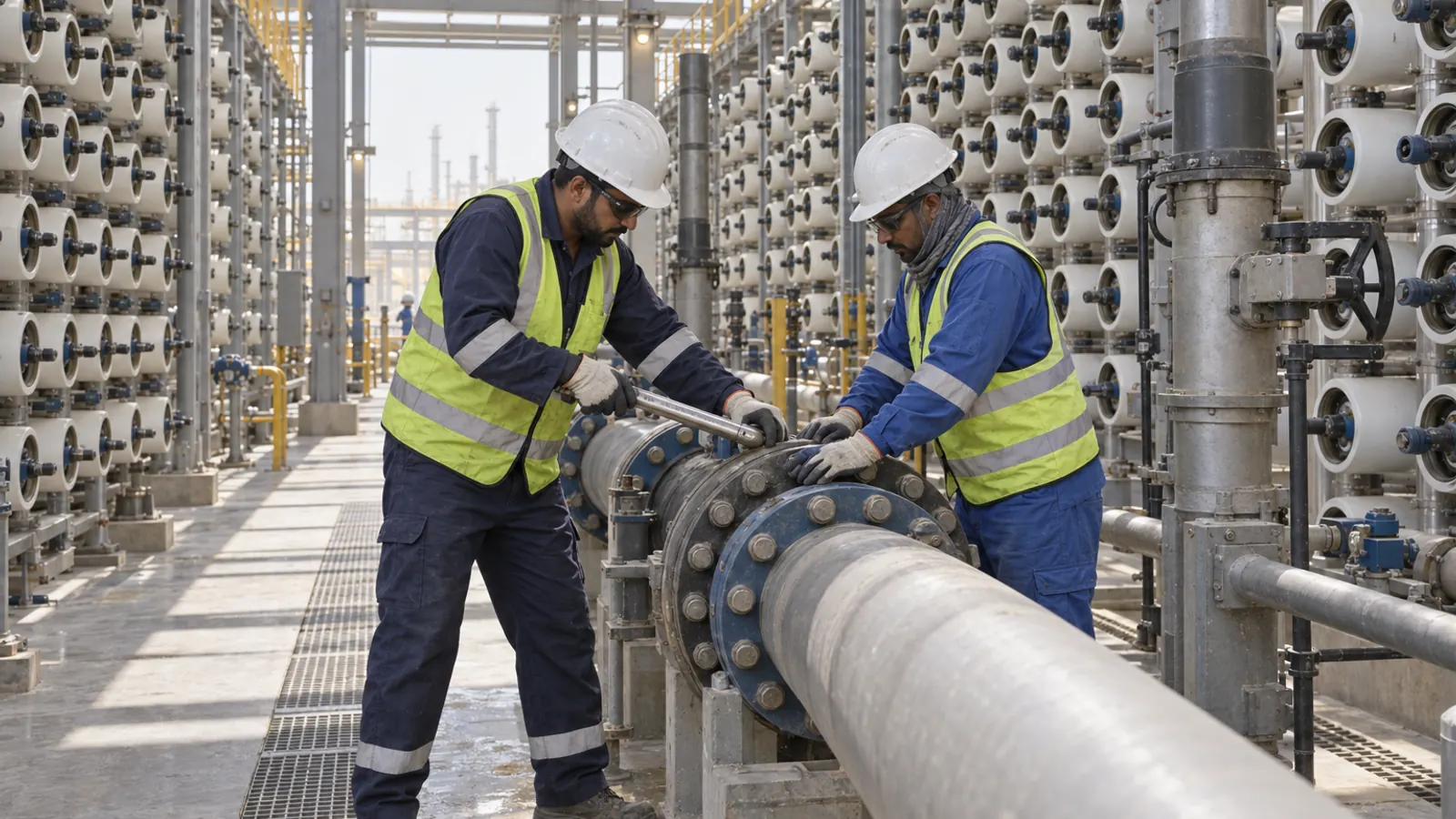
What the workforce looks like in this sector
A power or water requirement is mechanical and electrical at its core. Pipe fitters and welders work on seawater, brine, product-water and steam lines; mechanical fitters on pumps, turbine auxiliaries and energy-recovery equipment; electricians and E&I technicians on motors, switchgear, instruments and control systems. Scaffolders give access to boilers, evaporators and tanks, riggers and crane operators handle the heavy lifts, and insulators and coating painters protect the plant against heat and a marine environment. Supervision and HSE tie it to the plant's permit system.
Power and water often share one site
On the Saudi coasts, power generation and desalination are often built side by side, sharing steam, seawater intakes and electrical systems. A crew on such a site may move between the power block and the water plant in the same week. Say which parts of the site the scope covers, because the permit system, the materials and the trade mix differ between a turbine hall, an evaporator and a reverse osmosis train.
Outages are planned around summer demand
Electricity demand peaks in the Saudi summer, so major power plant outages and heavy maintenance are usually scheduled in the cooler months. That concentrates demand for fitters, welders, riggers and scaffolders into the same season across the utility sector. Send the outage dates as soon as they are set, with a provisional headcount per trade, so CV approval and security passes can start well before the window.
Seawater decides the materials, and the materials decide the welder
Seawater and brine service uses corrosion-resistant materials such as duplex and super duplex stainless steel, alongside GRP and HDPE pipe for intakes, outfalls and low-pressure lines. Welding duplex needs heat-input and purge control that carbon-steel experience does not provide, and GRP or HDPE jointing is a separate skill again. Name the materials, sizes and jointing methods in the RFQ; welders are then tested to your procedure (WPQ), and specialist jointing is confirmed per request.
Reverse osmosis and thermal plants need different mechanical skills
A reverse osmosis plant centres on high-pressure pumps, pressure vessels, membrane change-outs, energy-recovery devices and pretreatment filters. A thermal plant (multi-stage flash or multi-effect distillation) centres on evaporators, brine heaters, tube bundles, vacuum systems and steam supply. Mechanical fitters who know one are not automatically ready for the other. Say which technology the plant uses and what equipment the work covers, so fitters are matched to it.
Electrical work runs under the plant's authorisation
Utility plants control switching and isolation through their own authorised persons, and supplied electricians work under the plant's permits rather than switching equipment themselves. Say what voltage levels the work involves, whether it covers switchgear, motor control centres, cabling or instruments, and who holds the isolations. Panel electricians and E&I technicians can then be matched to the work, and the crew plan can allow for the time isolations take.
Pipelines, pumping stations and reservoirs inland
Desalinated water travels inland through long transmission pipelines with pumping stations and reservoirs along the route, and new substations and overhead lines extend the grid. That work behaves like an infrastructure package: a moving work front, long distances, and crews that live near the route. Give the route or station locations and where the crew will stay, so supervision, transport and productive hours are planned together. Accommodation and transport are quoted on request.
Desalination plants and the summer peak
Large plants such as Ras Al-Khair, with about 1.05 million cubic metres a day of desalination and 2.65 GW of power, combine thermal and reverse-osmosis units. Saudi power demand peaks in summer between noon and mid-afternoon, driven by air conditioning, so planned outages at power and water plants are usually scheduled away from the hottest months. Send the outage window early: it competes with every other plant's off-peak programme.
Site access in Power & Water
- Security clearance and gate pass
- Power and water plants are protected sites, and passes can take longer to issue than at an ordinary industrial plant. Send approved names and documents as soon as CVs are accepted, and ask the plant for its processing time.
- Permit-to-work and isolation
- Work runs under the plant's permit-to-work, with electrical and mechanical isolations applied by the plant's authorised persons. Share the permit process so the crew plan allows for permit issue at each shift.
- Cards and welder tests
- Scaffolders, riggers (Level III), crane and forklift operators carry TUV cards where the site requires them. Aramco-certified and non-Aramco workers are available if a site asks for one or the other. Welders qualify by procedure test (WPQ).
- Marine and intake works
- Work on seawater intakes, outfalls and jetties adds rules for working over or near water. List these in the RFQ; any specialised training they require is confirmed per site.
- Industrial city rules
- Plants inside the Royal Commission cities of Jubail, Ras Al-Khair and Yanbu add the city's entry rules to the plant's own. Name the plant's location so both are planned for, including where the crew is housed.
These are common sector practices, not legal requirements; what your site needs is confirmed per request.
Mobilization and RFQ response
Gulf Orbit has supplied operators for mobile cranes from 25 t to over 250 t (truck-mounted, rough-terrain and all-terrain).
In this sector, Gulf Orbit workers have been deployed through contractors on the Nairiyah IPP power plant. Project experience
- RFQ response:
- within 24 hours of a complete RFQ
- Mobilization:
- 48–72 hours from PO for in-Kingdom personnel, subject to worker documents and site approvals what can delay it
- Worker cards:
- TUV or Aramco card copies sent with CVs where the trade holds one
- Safety induction:
- completed by every worker before deployment; record kept
- Offices:
- Dammam (head office), Jubail Industrial City, Al Khobar
- Accommodation and transport:
- quoted on request