Updated: 2026-10-16·Reviewed by Jonaid Hassan, Business Development Manager
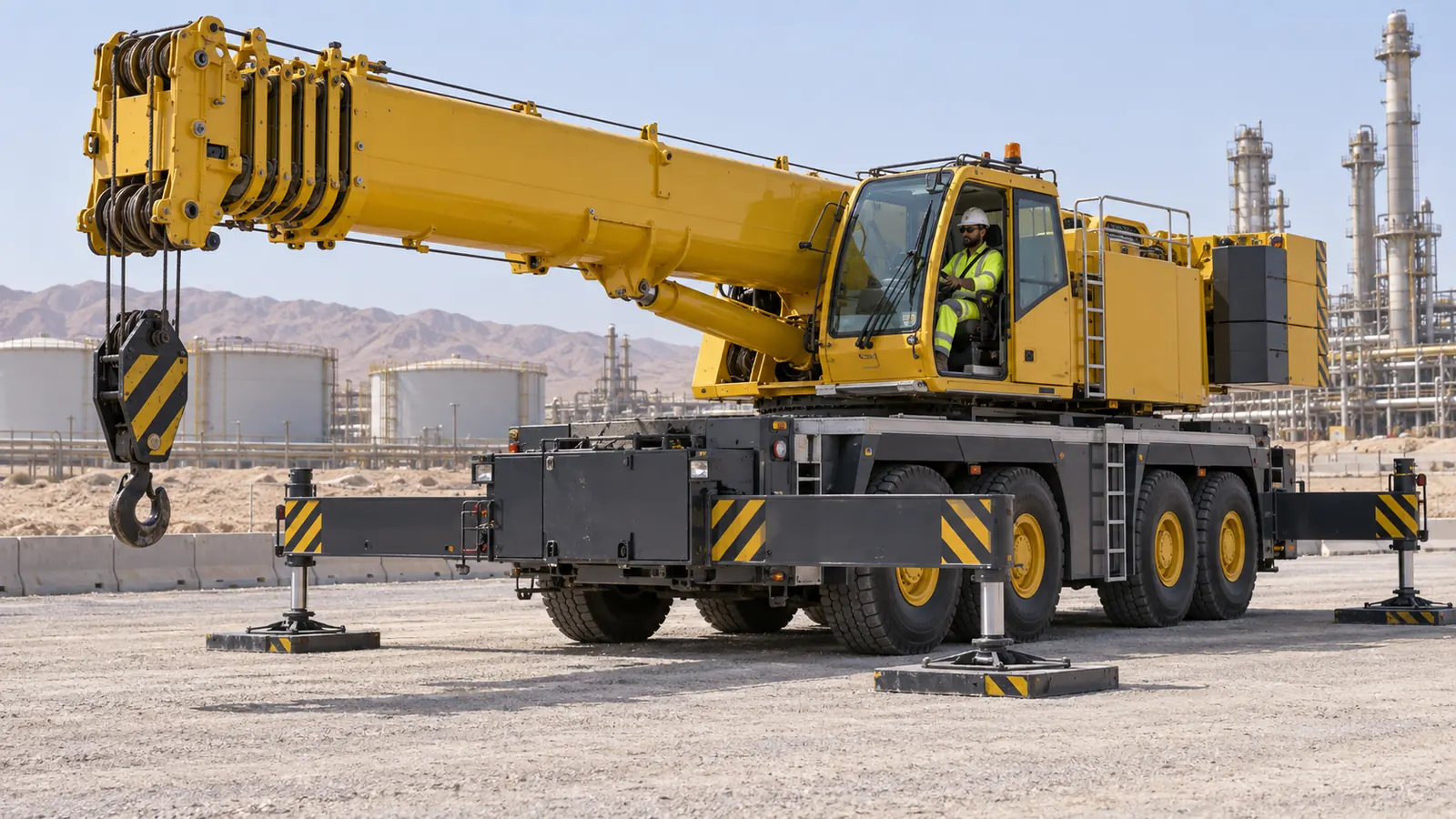
Operates mobile and all-terrain cranes for lifting on construction and industrial sites, including set-up, outrigger deployment and travel between lift positions.
Gulf Orbit supplies mobile crane operators to construction and industrial sites anywhere in Saudi Arabia, and has supplied operators for truck-mounted, rough-terrain and all-terrain cranes from 25 t to over 250 t. TUV-carded operators are available, with Aramco-certified or non-Aramco operators as your site requires.
Quick facts
Trade
Mobile Crane Operator · Site Management & Support
Worker cards
TUV-carded workers available; Aramco-certified or non-Aramco, as your site requires.
Crane types
Truck-mounted, rough-terrain (RT) and all-terrain (AT) mobile cranes
Capacity range
Operators supplied for cranes from 25 t to over 250 t
Usually supplied with
Level III riggers for slinging and signalling
Documents with the CV
CV, iqama and profession documents, plus card copies
Mobilization
Mobilization of in-Kingdom personnel to project sites anywhere in Saudi Arabia takes 48–72 hours from purchase order (PO), subject to worker documents and site approvals.
RFQ response
Complete RFQs get a response within 24 hours: a priced quotation, or an acknowledgement with any questions needed to price it.
What they do on site
Set up the crane, deploy outriggers and confirm ground bearing
Operate within the load chart for the configuration and radius
Carry out pre-use inspection and report defects
Work to the lift plan under rigger direction
What to put in your RFQ
State the crane type (truck-mounted, rough-terrain or all-terrain), its capacity in tonnes, and whether TUV or Aramco cards are required.
Mobile crane operators run hydraulic telescopic boom, rough-terrain (RT) and all-terrain (AT) cranes. Their work includes daily pre-start checks of wire ropes, hydraulic rams, hooks, and safety cut-outs, and checking outrigger mat placement and ground bearing before any lift.
Working to the lift plan
Lifting operations require absolute adherence to engineering lift plans. Crane operators interpret load capacity charts, verify boom length and operating radius, monitor Load Moment Indicators (LMI) and Anti-Two Block (A2B) systems, and maintain continuous two-way radio and standardized hand-signal communication with riggers and banksmen whose credentials meet the project requirements.
Shutdown deployment and site documents
In a plant turnaround, an idle crane holds up the critical path. Operator availability, required licenses and third-party competency records are reviewed for each site, and worker documents are reviewed per project, before a mobilization plan is confirmed.
Operator only, or crane and operator
Two different requests often arrive in the same words. If your site already has the crane, or it comes from a crane hire company, what you need is an operator, supplied as manpower and matched to that machine. If you need the crane as well, that is the equipment rental service line, where crane requests are reviewed against the lift and site requirements and quoted separately. Say which one you need. If the crane comes from a third party, name its make, model and capacity so the operator is matched to the machine rather than the job title.
What to check before they start
Match the operator's TUV card to the copy sent with the CV, and check that the crane type and capacity on the card cover the crane on your site.
Check that the CV shows work on your crane's make or a comparable model and capacity, and give the operator your load chart and configuration before the first lift.
Settle who assesses ground bearing and supplies outrigger mats before the crane sets up. That usually belongs to the lift planner, not the operator.
Review the lift plan with the operator and the riggers together, including the wind-speed limit and the signalling method.
On Aramco sites, state which operators must be Aramco-certified and check their card copies before you approve the CVs.
Typical crew shape
Every lift needs more than the operator. Level III riggers sling the load and give the signals, and a lift supervisor or appointed person owns the lift plan. Gulf Orbit supplies Level III riggers, so the lift supervisor role normally sits with your site team. On long shifts or shutdowns, ask for a relief operator so the crane keeps working when the first operator's hours run out.
Send how many workers you need for Mobile Crane Operator, the city, the start date and the duration. CVs and documents for each worker come to you for approval, and nobody mobilizes before you approve them. See the full request process
Frequently asked questions
What types and tonnages of mobile cranes do your operators handle?
Gulf Orbit has supplied operators for hydraulic truck, rough-terrain (RT) and all-terrain (AT) cranes from 25 tons to over 250 tons on construction and industrial sites. The operator is matched to the crane model and capacity on your site.
What licenses and third-party certifications do your operators hold?
TUV-carded crane operators are available, and Aramco-certified or non-Aramco operators can be supplied as your site requires. Card copies and the operator's licence come with the CV for your approval before mobilization.
Do your operators follow critical lift plans and tandem lift procedures?
Yes, against your site's lift procedures. Critical lift plans, tandem lifts, wind-speed limits and load chart requirements are confirmed before an operator is put forward.
Can you supply mobile crane operators for short-term plant shutdowns?
Yes. Crane operators can be quoted for turnarounds on shift schedules and short-to-medium term contracts.
What documentation is provided before a crane operator begins work?
Worker documents, including iqama, license and card copies, are reviewed per project before mobilization.
Do you supply riggers with the crane operator?
Yes, on the same RFQ. Gulf Orbit supplies Level III riggers, who sling loads and give signals to the operator. If your lift plan calls for a Level I or Level II rigger to supervise the lift, that role is not on the register, so keep it with your site team.