
Welder Qualifications Explained: 6G, 3G, TIG and MIG — What to Specify in a Manpower Request
A practical engineering guide to welder qualification test standards (ASME IX / AWS D1.1), explaining 6G, 3G, TIG, MIG, and essential WPS parameters for Saudi project requisitions.
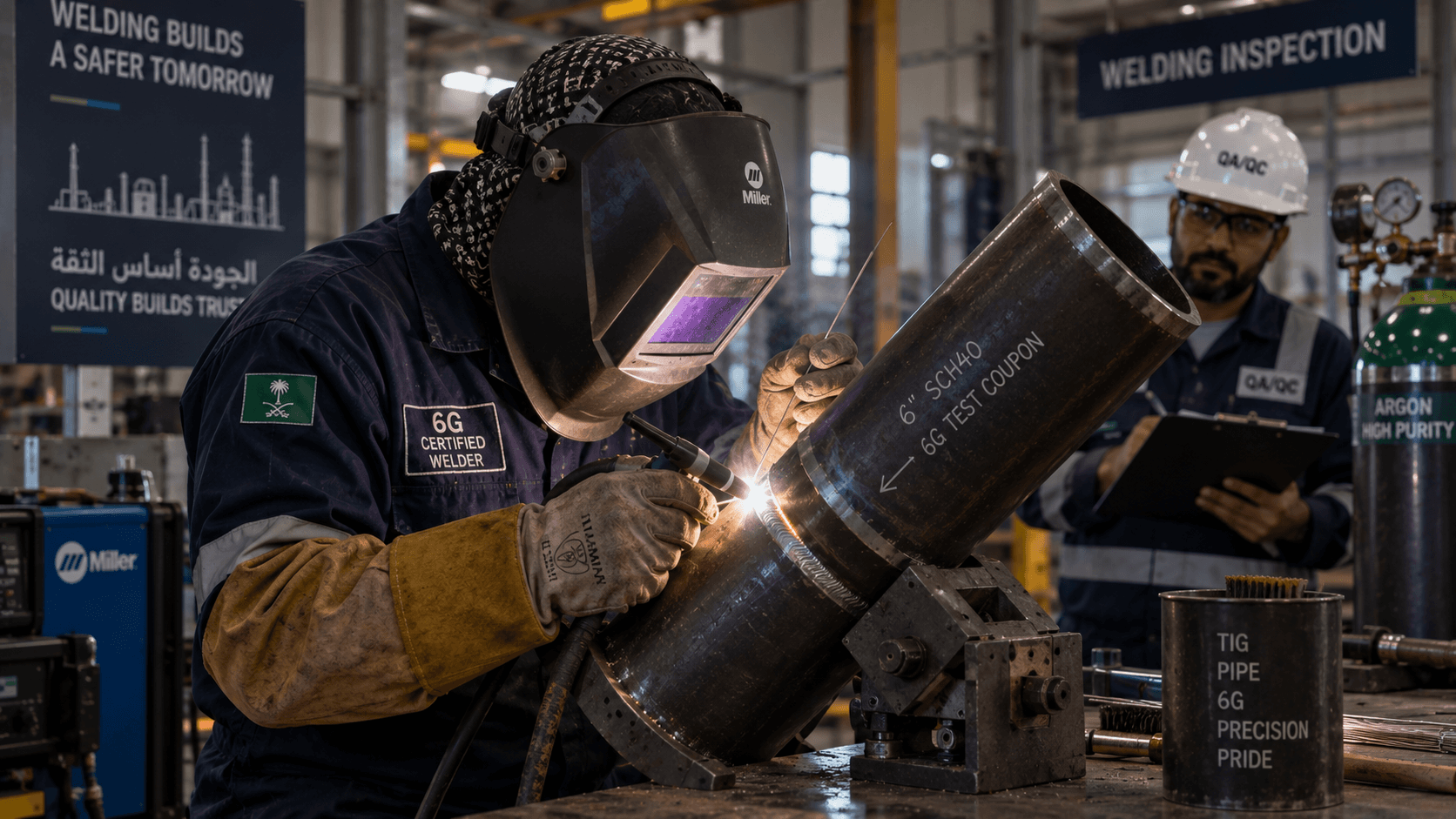
In Saudi industrial projects, welder qualifications depend on two separate variables: the welding position (such as 6G for fixed-inclined pipe or 3G for vertical plate) and the welding process (such as TIG/GTAW or MIG/GMAW). Specifying both parameters alongside material grade, thickness, and welding procedure specification (WPS) ensures supplied welders pass client trade tests on arrival.
Key takeaways
- 6G and 3G define test positions, while TIG, MIG, and SMAW define the welding process — a complete requisition specifies both.
- A 6G welder qualification (ASME Section IX) qualifies the craftsman for all plate and pipe positions (1G, 2G, 5G, 6G), making it the most versatile qualification.
- TIG (GTAW) is required for root passes and exotic alloys (stainless, duplex, Inconel), while MIG/FCAW or SMAW is used for rapid fill and cap passes.
- Client qualification trade tests in Saudi Arabia are rigorous; sending the approved WPS upfront prevents test coupon failures on site.
Positions vs. Processes: Why 'We Need Welders' is never enough
On petrochemical, oil and gas, and major industrial projects across Jubail, Yanbu, Dammam, and Ras Al-Khair, raising a manpower requisition that simply states '10 welders needed' is the most common cause of failed trade tests and delayed mobilisations.
A welder is not a generic trade. In industrial engineering, welder qualification is strictly governed by standards such as ASME Section IX (Boiler and Pressure Vessel Code), AWS D1.1 (Structural Welding Code), and API 1104 (Pipelines). These standards evaluate two completely independent parameters:
1. The Welding Position: Where the joint is located in physical space and whether the pipe or plate can be rotated (e.g., 1G, 2G, 3G, 4G, 5G, 6G). 2. The Welding Process: The technical method used to deposit weld metal (e.g., SMAW/Stick, GTAW/TIG, GMAW/MIG, FCAW/Flux-Cored).
When you engage welder supply services, matching the exact combination of position and process to your project's Welding Procedure Specification (WPS) is what separates a smooth site qualification from rejected coupons.
The Welder Qualification Matrix: Positions, processes, and standards
To assist piping engineers, QA/QC inspectors, and procurement managers in drafting accurate requisitions, the table below outlines the four primary welder categories deployed across Saudi industrial sites.
| Qualification Code | Process / Method | Position & Geometry | Inspection Standard | Best-Fit Saudi Site Scope |
|---|---|---|---|---|
| 6G X-Ray Welder | GTAW (Root) + SMAW (Fill/Cap) or Full SMAW | Pipe fixed at 45° angle (no rotation allowed) | 100% Radiographic Testing (RT) / ASME IX | Refinery turnaround, cross-country pipelines, plant process piping, boiler tubes |
| TIG / Argon Welder | GTAW (100% Argon Gas Shield) | All positions (Pipe and Plate) | Visual + Dye Penetrant (PT) / RT | Stainless steel (304L/316L), duplex, alloy piping, instrumentation tubing |
| MIG / FCAW Welder | GMAW (Solid Wire) / FCAW (Flux-Cored) | 1G, 2G, 3G (Flat, Horizontal, Vertical) | Visual + Ultrasonic Testing (UT) / AWS D1.1 | Structural steel fabrication yards, tank pre-assembly, heavy skid frames |
| 3G Plate Welder | SMAW (E7018 / E6010) or FCAW | Vertical plate (uphill progression) | Visual + Guided Bend Test / AWS D1.1 | Structural building frames, industrial pipe racks, storage tank vertical seams |
What 6G actually qualifies: The ASME Section IX position rule
A common question from contractors is why 6G X-ray welders command premium commercial rates. The reason lies in the mechanical difficulty of the test and the broad scope of qualification it confers.
In a 6G test, a pipe coupon is rigidly mounted at a 45-degree angle. The welder cannot rotate the pipe; they must weld uphill around both sides, continuously altering their torch angle, body position, and travel speed while transitioning through flat (1G), vertical (3G), overhead (4G), and horizontal (2G) orientations.
Under ASME Section IX, Table QW-461.9, successfully passing a 6G pipe qualification test qualifies the welder for: - All positions on pipe of any diameter down to the coupon limit (typically 2-inch OD and above). - All positions on plate (1G flat, 2G horizontal, 3G vertical, and 4G overhead). - Both groove and fillet welds across all joint geometries.
Because a 6G-qualified craftsman can handle virtually any structural or piping joint on site, they are the backbone of shutdown, turnaround, and tie-in packages where unpredictable field welds occur.
When TIG (Argon) is non-negotiable
While 6G defines geometry, Gas Tungsten Arc Welding (GTAW) — universally referred to on Saudi project sites as TIG or Argon welding — defines weld cleanliness and penetration control.
Deploying a TIG / Argon welder is non-negotiable in three specific scenarios:
1. Open-Root Passes on High-Pressure Pipe: When welding heavy-wall carbon steel or chrome-moly process piping, the root pass must be deposited using GTAW with an internal argon purge dam. TIG creates a smooth, defect-free internal weld bead without slag inclusion, ensuring laminar fluid flow and passing 100% radiographic examination. 2. Stainless Steel and High-Alloy Materials: Materials such as 304L, 316L, Duplex 2205, and Super Duplex will oxidize (sugar) on the backside if welded with stick electrodes without inert shielding. TIG with backing gas preserves the alloy's corrosion resistance. 3. Small-Bore Piping and Instrumentation: Hydraulic lines, turbine lubrication lines, and instrumentation tubing (under 2-inch diameter) cannot be welded with bulky stick electrodes; they require the precision arc control of TIG.
The manpower requisition checklist for piping and QA engineers
To ensure your manpower supplier provides craftsmen who pass client trade tests on the first attempt, include the following six technical parameters in your requisition:
1. Base Metal Specification: Specify material grade (e.g., Carbon Steel ASTM A106 Gr. B, Stainless Steel 316L, or P91 Alloy). 2. Diameter and Wall Thickness Range: State pipe outer diameter (e.g., 2" to 24") and schedule (e.g., Sch 40, Sch 80, Sch 160). 3. Welding Process Breakdown: State whether the joint requires GTAW root + SMAW fill/cap, full GTAW, or GMAW/FCAW. 4. Welder Position: Confirm whether 6G fixed pipe, 5G horizontal pipe, or 3G/4G structural plate is required. 5. Client Qualification Standard: Identify the applicable construction code (ASME B31.3 for process piping, ASME B31.1 for power piping, or AWS D1.1 for structural steel) and whether client pre-qualification coupon testing is mandatory. 6. Supporting Trades: Confirm whether welders will work with pipe fabricators for shop spooling or pipe fitters for site erection.
Ready to staff your upcoming welding package? Submit your technical requirements via our manpower request form, or contact our technical team to review availability for certified 6G and TIG crews across Saudi Arabia.
FAQ
Does a 6G welder qualification automatically qualify a welder for all pipe welding?
In terms of position, yes: under ASME Section IX, qualifying on a 6G pipe coupon qualifies the welder for all pipe and plate positions. However, the qualification is still restricted to the specific welding process (e.g., GTAW vs. SMAW), filler metal group (F-Number), and base metal thickness range specified on their Welder Performance Qualification (WPQ) record.
What is the difference between a 6G welder and a TIG welder?
6G refers to the welding position (pipe fixed at a 45-degree angle), whereas TIG (GTAW) refers to the welding process (using an inert argon gas shield and tungsten electrode). Many industrial pipe welders are qualified as 'TIG + Arc 6G' welders, meaning they use TIG for the critical root pass and SMAW (Stick) for the filler and capping passes.
Do client sites in Saudi Arabia require welders to be re-tested on arrival?
Yes. On major petrochemical, refinery, and energy sites across Saudi Arabia, third-party certification is only an entry ticket. Site QA/QC departments mandate an on-site trade test where the welder welds a coupon under the site's approved WPS, followed by visual inspection, bend testing, or radiographic (X-ray) examination before a site pass is issued.
What documents should accompany a welder's CV in a technical proposal?
A complete welder profile must include their Welder Performance Qualification (WPQ) record, third-party test laboratory certificates (indicating process, position, P-Number, and F-Number), previous Aramco/SABIC approval cards if applicable, an active Iqama with a matching welder profession code, and a fit-to-work medical certificate.