

Before You Accept a Welder on Site: WPQ Records, the Trade Test and X-Ray Results
Specifying the right welder is half the job. The other half is checking the WPQ records before mobilization, running the site trade test, and watching the first radiography results. What to check at each stage.
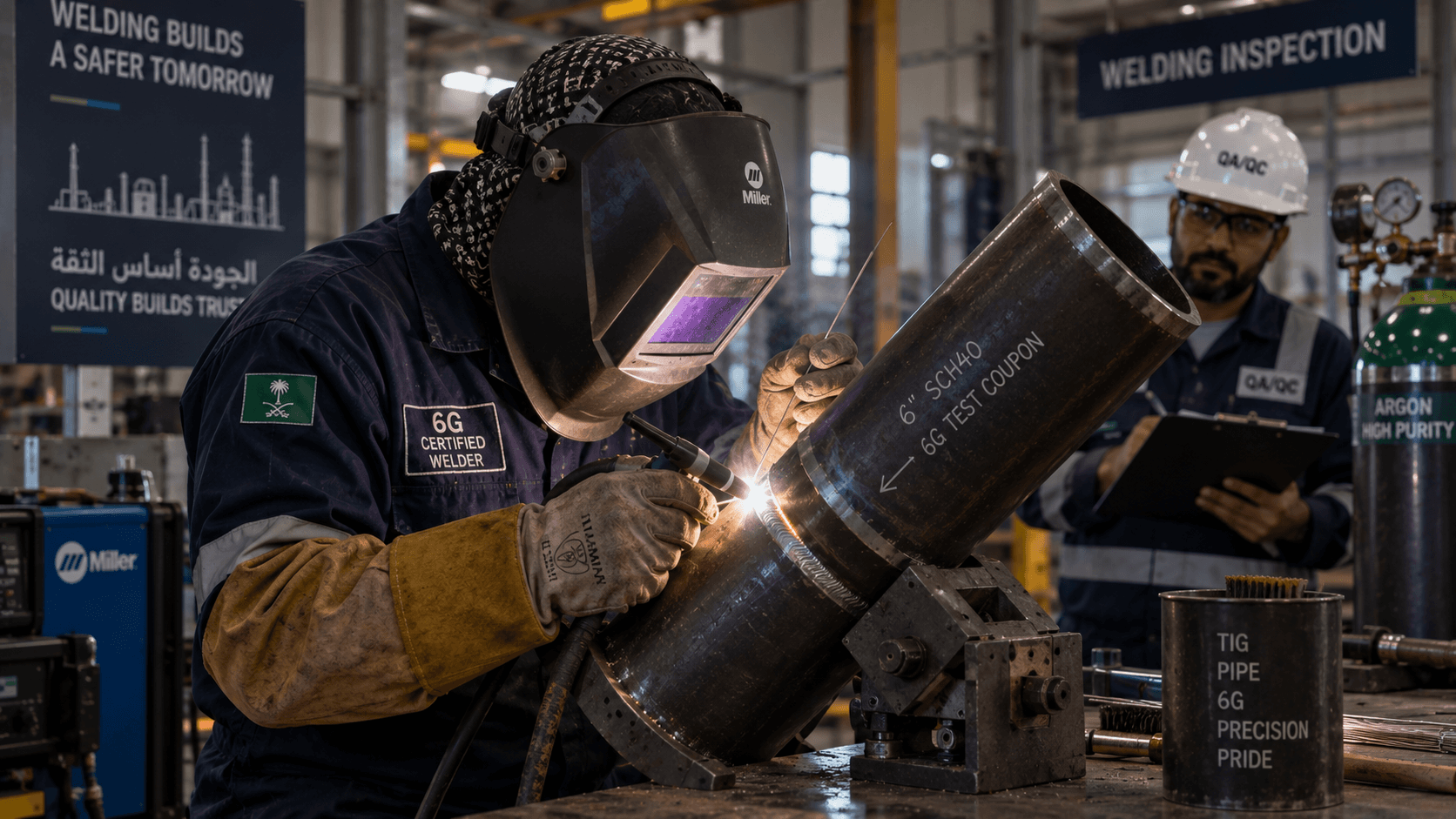
Accept a supplied welder in three stages. Before mobilization, check the WPQ records match your welding procedure (process, position, material and thickness range) and that the qualification is current. On arrival, run your site trade test against the same procedure. After the welder starts, watch the first radiography or ultrasonic results on production welds. State the test in the RFQ so welders are put forward against it.
Key takeaways
- Acceptance has three stages: records before mobilization, the trade test on arrival, and early production weld results.
- WPQ records must cover your process, position, material group and thickness range, and be kept current.
- Under ASME Section IX, a qualification lapses if the welder has not used the process for six months, so ask for continuity records.
- Most industrial clients test welders themselves before accepting them; describe the test in the RFQ.
- Welders are qualified by WPQ, not TUV cards.
Specifying and accepting are different steps
Our guide to welder qualifications covers what to put in a requisition: position, process, material, thickness and procedure. This guide covers what happens next: checking that the welders put forward actually match, before and after they reach the site. Most failed welder mobilizations are caught at one of these checks; the question is how early.
Stage 1: records before mobilization
Ask for each welder's WPQ records with the CV, and check them against your welding procedure specification (WPS) before you approve anyone.
- Process: the record covers the process in your WPS, for example GTAW root with SMAW fill and cap.
- Position: the qualified position covers the work. A 6G pipe test covers all positions within its diameter range; a 3G plate test covers far less pipe work, so check the range on the record.
- Material and thickness: the material group and thickness range on the record cover your pipe.
- Continuity: under ASME Section IX, a qualification lapses if the welder has not used the process for six months. Ask for continuity records, not just the original test certificate.
- Identity: the name matches the iqama and the CV, and the iqama profession fits the work. See iqama and profession codes.
Stage 2: the site trade test
Most industrial clients qualify welders themselves before accepting them on site, and that test is the real gate. It usually means welding a test coupon to your procedure, which is then inspected, often by radiography. Say in the RFQ that a test will be run and what it consists of (coupon, process, position and inspection method), so welders are put forward against that standard rather than against a job title. A mismatch found at matching stage costs an email; one found at the test booth costs the mobilization.
Stage 3: the first production welds
Passing a test coupon is not the same as producing sound welds in site conditions: access, wind, shift length and fit-up quality all differ. Your QA/QC team reviews the radiographic or ultrasonic results of the first production welds and tracks repairs by welder. Early results are the fastest signal of whether a welder matches the work, so review them in the first days, not at the end of the week.
Welders don't carry TUV cards
Scaffolders, riggers and crane operators are commonly checked for a TUV card at the gate. Welders are not: they are qualified by procedure tests recorded as WPQ. Ask for the WPQ records instead. For which trades commonly do need a card, see TUV card requirements by trade.
What to put in the RFQ
A welder request that states these can be matched and checked in one pass.
- The WPS, or its essentials: process, position, material, diameter and wall thickness range.
- The code the work is inspected against, and the inspection method (radiography or ultrasonic).
- Whether you will run a site trade test, and what it consists of.
- Quantity per welder category, site, start date, duration and shift pattern.
- Whether you also need fitters, fabricators or QA/QC inspection alongside the welders.
How Gulf Orbit supplies welders
Gulf Orbit's register includes 6G X-ray welders and TIG / Argon welders, alongside pipe fitters, fabricators and QA/QC inspectors. Send the procedure and the test with the RFQ through welder supply. Mobilization of in-Kingdom personnel takes 48–72 hours from purchase order, subject to worker documents and site approvals.
FAQ
What should I check before accepting a supplied welder?
Check the WPQ records match your WPS (process, position, material and thickness range) and are current, run your site trade test against the same procedure, and review the first radiography or ultrasonic results on production welds.
How long does a welder qualification stay valid?
Under ASME Section IX, a welder's qualification for a process lapses if they have not used that process for six months. Ask for continuity records, not only the original test certificate.
Do welders need a TUV card?
No. Welders are qualified by procedure tests recorded as WPQ, not by TUV cards. Ask for the WPQ records.
Should the site trade test be in the RFQ?
Yes. Describe the coupon, process, position and inspection method, so welders are put forward against that test rather than a job title.