
Iqama, Work Permits and Profession Codes — Why They Decide Who Can Work on Your Site
Why industrial plant gates reject workers with mismatched Iqama profession codes, how the Saudi Skill Verification Program applies, and how to verify compliance.
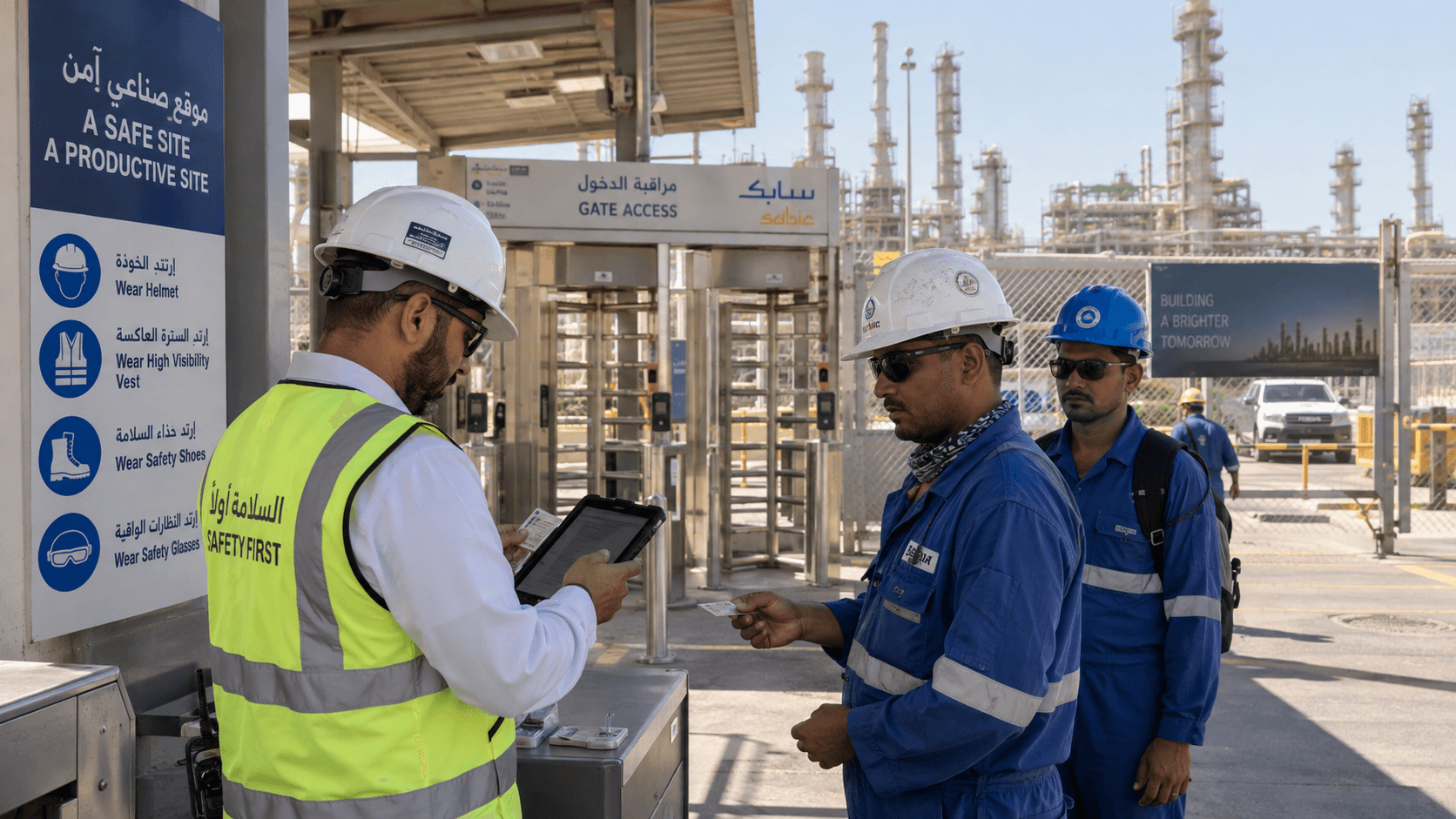
In Saudi Arabia, industrial site gate passes require that a worker's Iqama profession code matches their actual scope of work. Sending a worker with a 'General Laborer' (`عامل عادي`) Iqama to perform 6G welding, scaffolding erection, or electrical cabling causes immediate security gate rejection and safety audit violations.
Key takeaways
- Industrial site security and QA/QC departments cross-check physical Iqama profession codes against actual work tasks.
- Under Article 38 of the Saudi Labor Law, employing a worker in a profession different from their registered work permit is a punishable offense.
- The Saudi Skill Verification Program (SVP) requires expatriate craftsmen to pass theoretical and practical exams to hold designated profession titles.
- Mismatched profession codes lead to immediate gate pass rejection, stalled work fronts, and severe regulatory fines during site audits.
The site gate reality: Why security and safety inspect Iqama professions
On commercial job sites, security checks may occasionally focus only on basic identity and residency validity. However, on industrial sites — including petrochemical complexes in Jubail and Yanbu, mining facilities in Ras Al-Khair, and infrastructure developments across the Kingdom — security gate personnel and HSE inspectors inspect the exact profession title recorded on the physical Iqama card and in the Qiwa database.
If a contractor requests a 6G X-ray welder or an industrial electrician, but the supplied worker's Iqama states 'Laborer' (عامل) or 'Agricultural Worker' (عامل زراعي), the worker will be denied gate access on the spot. Clients and site owners refuse admission because allowing an uncertified worker to execute high-risk trades creates immense safety and structural liability.
Common profession code conflicts on construction and industrial sites
The practice of dispatching craftsmen under generic or inaccurate Iqama codes is one of the most persistent issues among low-tier labor brokers in Saudi Arabia. Contractors must understand which profession titles are acceptable for specific trade scopes.
| Actual Site Role | Mismatched Code (High Risk) | Compliant Iqama Code | Gate Pass Outcome |
|---|---|---|---|
| 6G High-Pressure Welder | General Laborer (عامل عادي) or Blacksmith | Welder (لحام) / Pipe Welder | Rejected at industrial gates without welder trade Iqama & SVP certification |
| Access Scaffolder | Loading Worker (عامل شحن وتفريغ) | Scaffolder (فني سقالات) / Steel Erector | Requires certified scaffolder card and technical Iqama title for height work |
| Industrial Electrician | Maintenance Helper (مساعد صيانة) | Electrician (كهربائي تمديدات / فني) | Barred from live panels and electrical rooms without certified trade title |
| Mobile Crane Operator | Light Driver (سائق خاص / سائق عمومي) | Heavy Equipment Operator (سائق معدات ثقيلة) | Gate denied without matching equipment operator code and valid heavy license |
| Pipe Fabricator | Mason (بناء) or General Helper | Pipe Fabricator / Industrial Fitter | Blocked from piping spool fabrication areas during client QA/QC audit |
The Saudi Skill Verification Program (SVP)
To professionalize the construction and industrial workforce, the Ministry of Human Resources and Social Development (HRSD) implemented the Professional Accreditation and Skill Verification Program (SVP) in partnership with Takamol and technical training institutions.
Under this program, expatriate workers in targeted craft occupations must pass both a written theoretical exam and a hands-on practical test before their Iqama profession can be issued or renewed. When procurement teams request skilled trades from a reputable manpower supply provider, the supplier should provide proof of SVP certification, ensuring that the worker is recognized as competent by both Saudi authorities and industrial quality auditors.
Legal ramifications under Article 38 of the Saudi Labor Law
Deploying workers in trades outside their registered Iqama profession violates Article 38 of the Saudi Labor Law, which explicitly states:
> *'An employer may not employ a worker in a profession other than the one specified in his work permit, nor may a worker engage in a profession other than his permitted profession before completing the statutory procedures for changing his profession.'*
During site labor inspections, violations of Article 38 result in: - Financial penalties ranging from SAR 10,000 to SAR 25,000 per violation. - Immediate confiscation of site access passes and expulsion from the project site. - Delays in project delivery while replacement personnel are sourced and vetted. - Downgrades in the contractor's internal safety and compliance audits.
How to specify profession requirements in your manpower requisition
To ensure that your manpower partner delivers personnel who pass site gate inspections on the first attempt, follow these requisition guidelines:
1. Specify Exact Iqama Profession: Do not simply request '10 fitters' — specify '10 Pipe Fitters with matching Iqama profession code and industrial site experience'. 2. Demand Iqama Scans in Bid Review: Review physical Iqama copies and verify profession titles during technical bid evaluation. 3. Include SVP Requirements: For mechanical, electrical, and access trades, mandate proof of Saudi Skill Verification Program accreditation. 4. Audit Prior to Mobilisation: Verify that the profession printed on the worker's Ajeer notice aligns perfectly with the physical Iqama card.
Learn more about Gulf Orbit's stringent trade verification standards on our trust and compliance page, or submit your specific trade requisition through our manpower request form.
*Regulatory Note: This article provides operational guidance for contractors in Saudi Arabia and does not constitute formal legal advice. Compliance requirements should always be validated against current HRSD and Qiwa regulations (Last reviewed: September 2026).*
FAQ
Can a worker with a 'Laborer' (عامل) Iqama legally work as a welder on site?
No. Under Article 38 of the Saudi Labor Law, a worker cannot perform skilled trade duties outside their registered work permit. Industrial site security and QA/QC inspectors will reject gate passes for welders whose Iqama lists them as general laborers.
How does the Skill Verification Program (SVP) affect trade hiring?
The SVP ensures that expatriate craftsmen in designated trades (welding, plumbing, electrical, carpentry) have demonstrated practical and theoretical competence. Workers who have passed SVP carry verified credentials recognized by Saudi authorities.
Can an Iqama profession be changed quickly if there is a mismatch?
Changing an Iqama profession requires an application through the Qiwa platform, submission of verified trade certificates, payment of government fees, and approval by HRSD and Jawazat. The process takes several days to several weeks and must be handled by the primary sponsor.
Does Gulf Orbit verify that Iqama profession codes match requested trades?
Yes. Gulf Orbit enforces strict trade alignment. Craftsmen deployed for specialized scopes — such as 6G welders, scaffolders, and crane operators — hold matching profession codes and verified competency certifications.