
Ajeer Explained: How Manpower Dispatch Compliance Works in Saudi Arabia
A complete operational guide for Saudi contractors and procurement teams on Ajeer notices, dispatch rules, Qiwa integration, and avoiding unlicensed labour penalties.
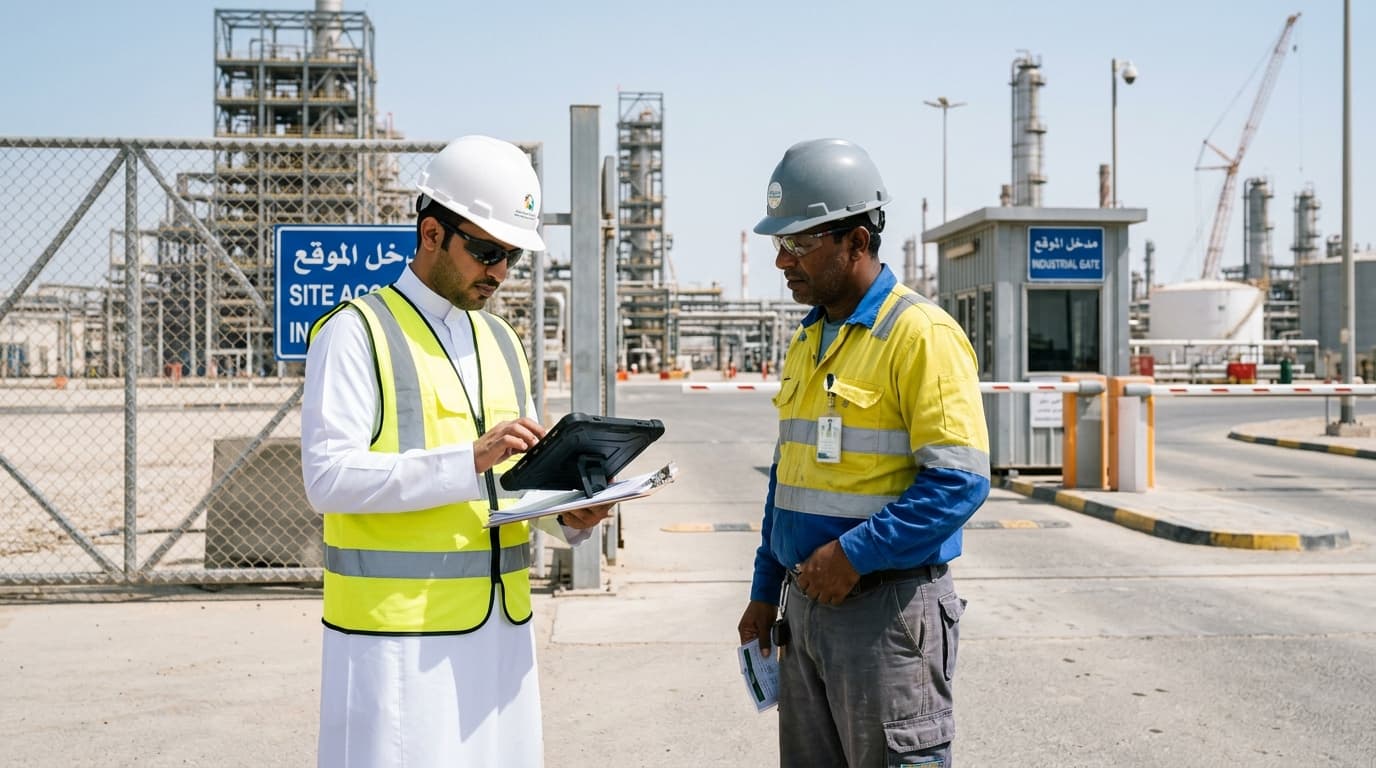
In Saudi Arabia, Ajeer is the Ministry of Human Resources and Social Development (HRSD) digital framework that legally authorizes an establishment to dispatch its sponsored employees to work temporarily on another contractor's site without transferring sponsorship, preventing severe penalties under Article 39 of the Saudi Labor Law.
Key takeaways
- Ajeer notices legally decouple operational site supervision from direct employer sponsorship for defined project periods.
- Deploying supplied personnel on a Saudi project without an active Ajeer notice violates Article 39 of the Saudi Labor Law.
- Ajeer contracts are executed business-to-business via the Qiwa platform, registering each worker to a specific client and site.
- Supplied personnel operating under Ajeer remain registered on the supplier's Nitaqat file, shielding the client contractor's Saudization quota.
What is Ajeer and why is it mandatory on Saudi project sites?
Under the Saudi Labor Law, an employer is strictly prohibited from allowing its expatriate employees to work for any third party without legal authorization, and contractors are prohibited from employing workers sponsored by other companies. Historically, this created major bottlenecks for construction, maintenance, and turnaround projects that experience sharp peaks in labor demand.
To resolve this while maintaining strict regulatory oversight, the Ministry of Human Resources and Social Development (HRSD) established the Ajeer platform, now fully integrated into Qiwa. Ajeer provides a digital framework that issues legally binding dispatch notices (إشعار عمل), authorizing sponsored workers of a licensed supplier to execute duties at a client's project site. Without this notice, workers entering your gates can be classified as illegal labor during ministry inspections, exposing both parties to immediate penalties.
For contractors engaging manpower supply services, an active Ajeer notice is the single most important document separating lawful commercial dispatch from black-market labor leasing.
Contractual models: Direct sponsorship vs. Ajeer dispatch vs. Subcontracting
Procurement and contracts managers in Saudi Arabia frequently confuse three distinct mechanisms for engaging on-site labor. Each carries different legal liabilities, administrative overhead, and site-access rules.
| Model / Framework | Legal Basis | Sponsorship Transfer? | Gate Pass Validity | Procurement Suitability |
|---|---|---|---|---|
| Direct Sponsorship | Standard Labor Contract & Iqama | Yes (Full sponsorship transfer) | Direct through employer CR | Long-term core management & permanent workforce |
| Ajeer Work Notice (إشعار عمل) | HRSD Ajeer Regulations via Qiwa | No (Worker remains on supplier sponsorship) | Fully valid with official Ajeer QR code | Project peak demand, plant shutdowns, specialized trades |
| Lump-Sum Subcontracting | Commercial Subcontract Agreement | No (Under subcontractor entity) | Issued under subcontractor's approved scope | Complete standalone work packages with contractor-managed deliverables |
How Ajeer contract issuance works via Qiwa
Generating an Ajeer notice is not a manual paper filing; it is an integrated electronic workflow between two registered Saudi establishments on the Qiwa platform.
1. Establishment Agreement: The client contractor and the manpower supplier enter into an electronic labor supply contract on Qiwa, specifying the project duration, scope, and number of workers. 2. Worker Allocation: The supplier assigns specific sponsored workers from its digital employee roster to the contract. The system verifies that each worker holds a valid Iqama and that the supplier maintains an eligible Nitaqat tier. 3. Notice Generation: Upon digital acceptance by the client, individual Ajeer Work Notices are issued, complete with verification QR codes, the worker's identification number, and the designated project location. 4. Validity and Extensions: Ajeer notices are typically issued for durations matching project milestones (up to 12 months) and can be renewed electronically as project scopes extend.
Compliance risks and penalties under Saudi Labor Law
Failure to comply with Ajeer requirements carries substantial commercial and legal ramifications under Article 39 of the Saudi Labor Law. Penalties enforced during joint inspections by the Ministry of Human Resources and the Ministry of Interior include:
- Financial fines reaching up to SAR 100,000 per unauthorized worker. - Suspension of recruitment privileges and Qiwa electronic services for up to five years. - Mandatory deportation and five-year re-entry bans for expatriate workers caught working without valid documentation. - Potential blacklisting from bidding on government, Royal Commission, and sovereign wealth fund mega-projects.
Reviewing supplier credentials on prequalification and verifying Ajeer documentation before allowing personnel past your site gates is essential risk management.
Pre-mobilisation verification checklist for contractors
Before issuing site security passes or inducting dispatched crews into work zones, contractor HSE and procurement teams should verify the following four checkpoints:
1. Scan the QR code on the Ajeer notice using a mobile device to confirm active status on the official Qiwa database. 2. Cross-check the worker's name, nationality, and Iqama number against the physical Iqama card. 3. Verify that the project location specified on the notice matches your actual project site or regional scope. 4. Confirm that the notice expiration date extends beyond the anticipated work front duration, scheduling renewal milestones well in advance.
To review how Gulf Orbit structures fully compliant commercial manpower dispatches, visit our trust and compliance overview or submit your requisition directly through our manpower request portal.
*Regulatory Note: This article provides operational guidance for contractors in Saudi Arabia and does not constitute formal legal advice. Compliance requirements should always be validated against current HRSD and Qiwa regulations (Last reviewed: September 2026).*
FAQ
Does an Ajeer notice transfer worker sponsorship to our company?
No. Ajeer does not transfer sponsorship. The worker remains under the direct sponsorship and legal payroll of the manpower supplier. Ajeer simply provides statutory authorization for the worker to perform temporary services on your designated site.
How long does it take to issue an Ajeer notice on Qiwa?
Once the commercial agreement is confirmed and the client accepts the electronic request on Qiwa, Ajeer notices are typically generated within 24 to 48 hours, provided both establishments maintain eligible Nitaqat ratings and the workers have valid Iqamas.
Can an Ajeer worker work across multiple project sites in different cities?
Ajeer notices designate specific geographic locations or project agreements. If workers need to be redeployed from Dammam to Jubail or Yanbu, the supplier must update or reissue the Ajeer notice to reflect the new work site to maintain full inspection compliance.
Who is responsible for the worker's GOSI and medical insurance under Ajeer?
The primary sponsor (the manpower supplier) remains legally obligated to maintain GOSI contributions (including the 2% Occupational Hazards branch) and valid CCHI health insurance for all dispatched personnel.