
What Documents to Request From a Manpower Supplier Before Mobilisation
The definitive pre-mobilisation compliance checklist for Saudi contractors: corporate registrations, Qiwa authorizations, and individual worker gate dossiers.
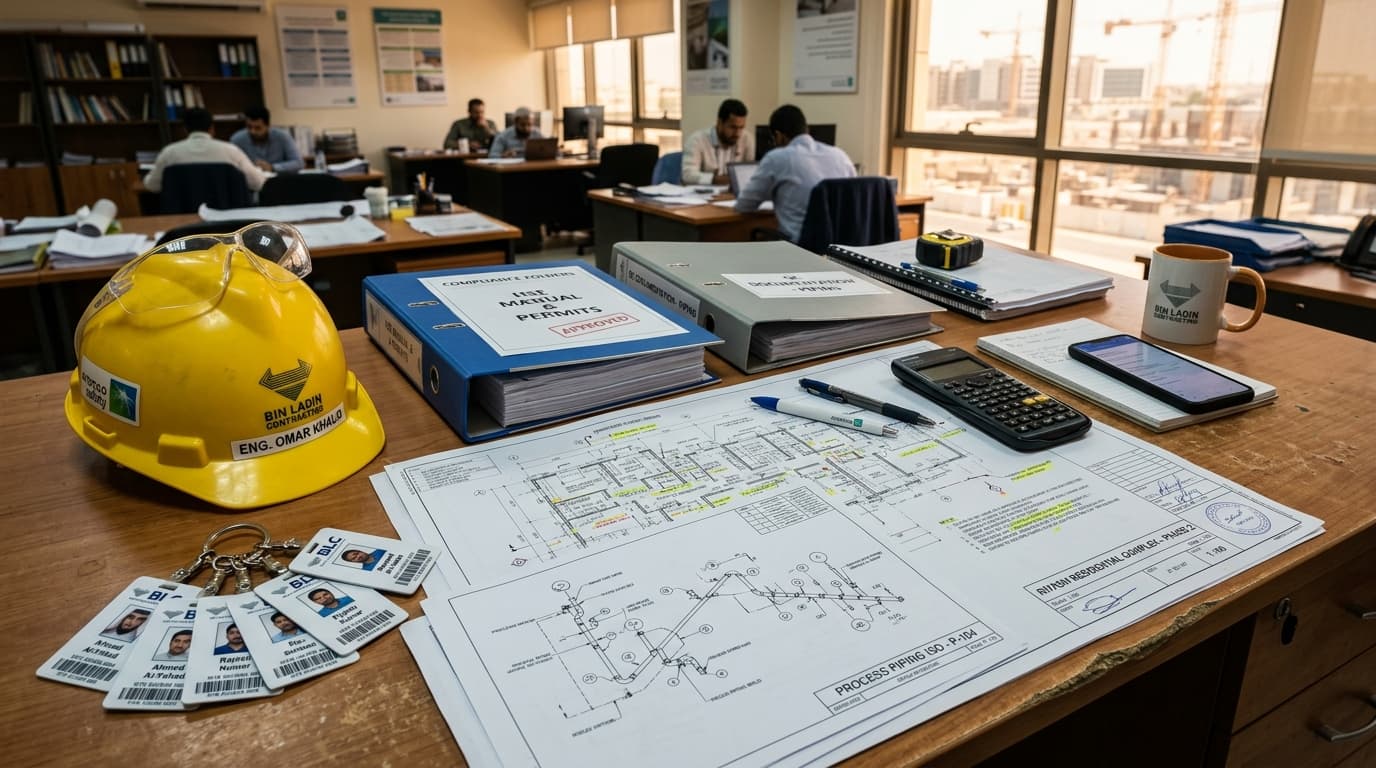
Before mobilising supplied manpower in Saudi Arabia, contractors must request two documentation sets: corporate compliance records (Commercial Registration, GOSI certificate, ZATCA tax clearance, Saudization certificate, Chamber membership) and worker-level dossiers (valid Iqama, Ajeer notice, medical fitness, trade certificates, and site gate pass photos).
Key takeaways
- Incomplete pre-mobilisation documentation is the single leading cause of gate access delays on Saudi industrial sites.
- Corporate documentation verifies the supplier's legal capacity, tax standing, and insurance coverage under Saudi law.
- Worker dossiers must include an active Ajeer notice, valid Iqama, medical fitness certificate, and trade competency credentials.
- Rigorous pre-qualification reduces commercial liability and prevents project shutdown during government labor inspections.
The high cost of incomplete mobilisation files
On major industrial and construction projects across Dammam, Jubail, Yanbu, and Riyadh, mobilizing a craft crew is not as simple as dispatching a bus to the front gate. Industrial complexes, refineries, and commercial job sites enforce stringent security gate protocols. If a single worker lacks a verified Ajeer notice, has an expired medical certificate, or presents an Iqama with an incompatible profession code, security will turn the entire crew away.
For the contractor, this creates immediate losses: idle equipment, postponed crane lifts, stalled welding lines, and missed critical path milestones. Establishing a standardized document collection and verification process during procurement eliminates these delays before workers arrive at the gate.
Corporate compliance checklist (Establishment Level)
Before reviewing individual worker CVs or trade certificates, procurement teams must verify the supplier's corporate standing. Engaging an unlicensed or non-compliant entity exposes your business to vicarious liability and contract nullification.
| Document Name | Issuing Authority | Validity Check | Why It Matters on Site |
|---|---|---|---|
| Commercial Registration (CR) | Ministry of Commerce | Active status; must include authorized manpower supply activity | Proves corporate legal standing and contractual capacity |
| GOSI Compliance Certificate | General Organization for Social Insurance | Issued within the past 3 months; valid electronically | Confirms employer insurance contributions and injury coverage |
| ZATCA Tax Clearance Certificate | Zakat, Tax and Customs Authority | Valid for the current fiscal year | Ensures supplier is in good standing and eligible for VAT invoicing |
| Saudization / Nitaqat Certificate | Ministry of Human Resources (HRSD) | Shows Green or Platinum tier status | Confirms eligibility to issue automated Ajeer notices via Qiwa |
| Chamber of Commerce Membership | Local Chamber (Asharqia, Riyadh, etc.) | Current annual membership | Required for attestation of commercial agreements and guarantees |
| Ajeer Work Notice (إشعار عمل) | HRSD / Qiwa Platform | Active status with verifiable QR code; lists correct site location | Statutory authorization preventing illegal labor penalties under Article 39 |
| Worker Iqama & Medical Fitness | Jawazat & Certified Occupational Clinic | Minimum 3 months validity; fit-to-work medical clearance | Mandatory for site gate pass issuance and HSE site induction |
Worker-level gate dossier checklist (Field Level)
Once the supplier's corporate credentials are confirmed, a complete digital dossier must be compiled for every individual craftsman slated for mobilisation:
1. Clear Iqama Copy: Both front and back, with at least 90 days of remaining validity before renewal. 2. Ajeer Work Notice: Generated specifically for your project contract, detailing the worker's full name, Iqama number, and approved work location. 3. Medical Fitness Certificate: Issued by an accredited occupational health center, including baseline audio, pulmonary, and vision screening for high-risk trades. 4. Trade Competency Certificates: Third-party qualifications (such as AWS/CSWIP for 6G welders, TUV/Aramco approvals for riggers, or certified scaffolder cards for scaffolders). 5. Driver / Operator Licenses: Valid Saudi government licenses and third-party heavy equipment certifications for crane operators and forklift operators. 6. Passport-Sized Photographs & National ID: Required by site security departments for magnetic gate badges and RFID tracking passes.
Plant-specific gate requirements (Aramco, SABIC, RCJY Gates)
Industrial petrochemical facilities and Royal Commission zones enforce security standards that exceed standard commercial construction sites. Gate applications in Jubail Industrial City or Ras Tanura typically require:
- Security Clearance / Background Check: Processed through High Commission for Industrial Security (HCIS) channels. - Plant Safety Induction Cards: Proof of completion of plant-specific hazard awareness courses (e.g., H2S awareness, confined space entry, working at heights). - Mandatory PPE Compliance Sign-off: Evidence that workers have been issued flame-resistant clothing (FRC), safety footwear, and task-specific PPE meeting plant specifications.
Suppliers experienced in industrial staffing will have these dossiers pre-assembled, drastically shortening the gate pass turnaround time.
Standard operating procedure for procurement onboarding
To keep your project on schedule, establish a clear pre-mobilisation timeline with your manpower supplier:
- T-minus 14 Days: Execute commercial agreement and verify supplier corporate documents on Qiwa and ZATCA. - T-minus 7 Days: Receive worker dossiers, verify trade certificates, and submit gate pass applications to site security. - T-minus 3 Days: Generate electronic Ajeer notices on Qiwa and conduct internal QA/QC document audits. - T-minus 1 Day: Confirm gate pass issuance, accommodation logistics, and transportation routing. - Day 1: Conduct site safety induction and deploy crews directly to active work fronts.
To review our prequalification documentation or request a structured manpower quote, visit our prequalification page or submit your scope via our manpower request portal.
*Regulatory Note: This article provides operational guidance for contractors in Saudi Arabia and does not constitute formal legal advice. Compliance requirements should always be validated against current HRSD and Qiwa regulations (Last reviewed: September 2026).*
FAQ
How long does it take to secure industrial gate passes for supplied workers?
Standard commercial construction gates typically process passes within 24 to 48 hours. Major industrial plants (Aramco, SABIC, Royal Commission) require 5 to 10 working days due to security background vetting and plant induction scheduling.
Can we accept a worker whose Iqama has less than 30 days of validity?
It is strongly discouraged. Most industrial clients reject gate pass applications if an Iqama expires within 30 days, as an expired Iqama invalidates gate access and exposes the site to compliance violations.
What medical tests are required for pre-mobilisation clearance?
Standard clearance requires a general physical exam, infectious disease screening, blood pressure evaluation, and drug/alcohol screening. High-risk trades (welders, scaffolders, crane operators) also require pulmonary function, audiometry, and vision depth testing.
Does Gulf Orbit provide pre-assembled documentation packets for rapid gate approval?
Yes. Gulf Orbit compiles standardized compliance dossiers for all deployed personnel — including active Ajeer notices, clear Iqama copies, medical clearances, and verified trade certifications — tailored to client and facility gate specifications.