GOSI, Insurance and Liability — Who Carries What in a Manpower Supply Contract
Clear breakdown of GOSI Occupational Hazards, health insurance (CCHI), third-party site liability, and indemnification between supplier and contractor.
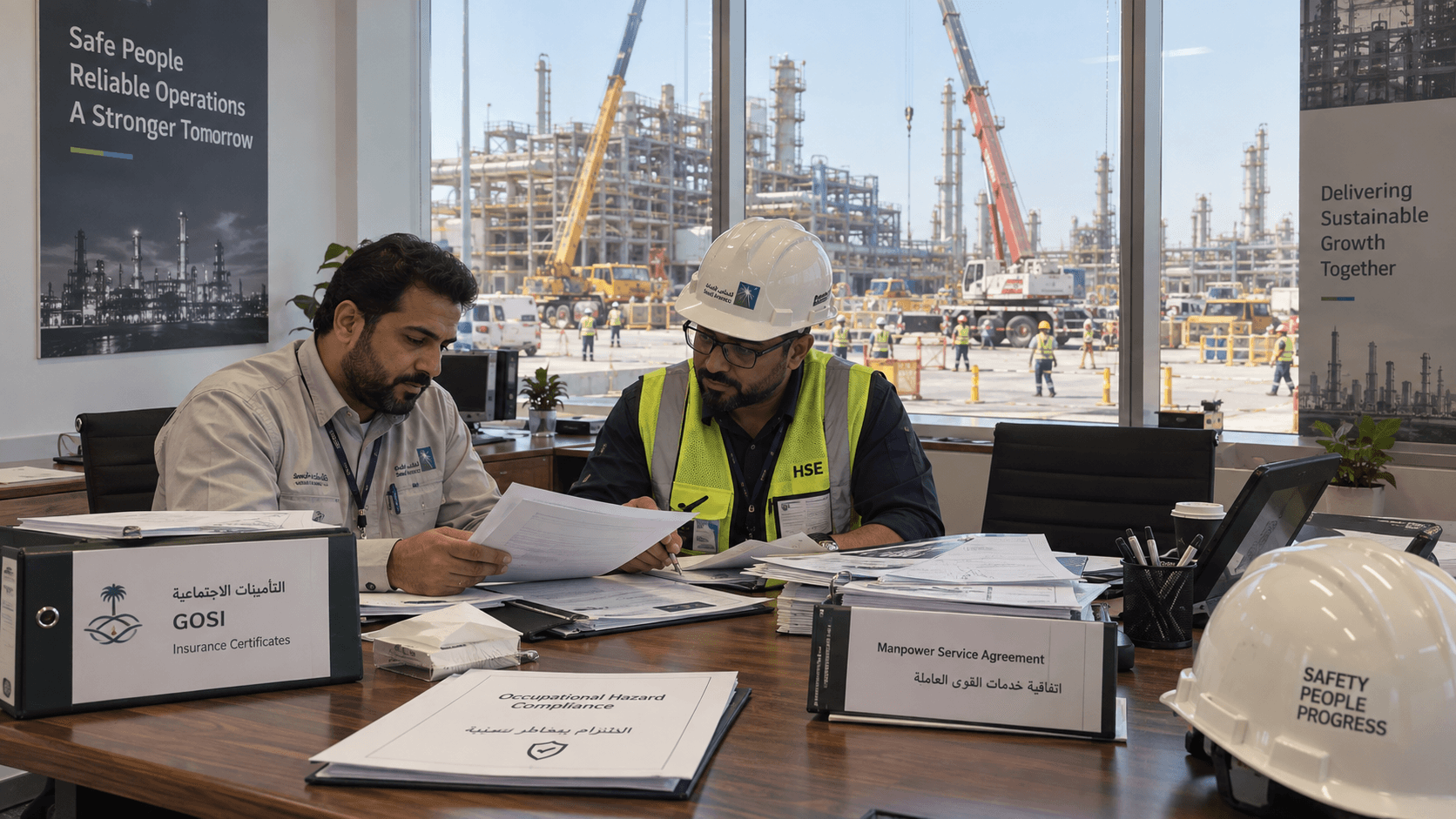
In a compliant Saudi manpower supply contract, the supplier retains statutory liability for GOSI contributions (including the 2% Occupational Hazards branch) and mandatory CCHI health insurance, while the client contractor maintains operational site safety supervision and third-party site liability insurance.
Key takeaways
- The manpower supplier is legally responsible for mandatory GOSI contributions, including the 2% Occupational Hazards scheme.
- Private medical insurance under Council of Cooperative Health Insurance (CCHI) guidelines remains the legal duty of the primary sponsor.
- The client contractor carries operational duty of care and must provide site-specific safety inductions, safe equipment, and valid work permits.
- Contractual indemnification clauses must explicitly define liability for workplace accidents, equipment damage, and regulatory non-compliance.
The division of responsibility: Statutory vs. operational liability
When entering into a temporary manpower supply agreement in Saudi Arabia, clarity on insurance and legal liability is paramount. A poorly drafted contract that fails to delineate statutory employer obligations from operational site management can expose both parties to devastating financial and legal exposure in the event of an accident.
In the Saudi legal framework, liability is divided into two distinct tiers: 1. Statutory Employer Liability: Legal obligations attached to the sponsorship of the worker under the Social Insurance Law and Cooperative Health Insurance Law. These obligations strictly belong to the manpower supplier. 2. Operational Site Liability: Obligations arising from the physical control, supervision, and safety management of the active work front. These obligations belong primarily to the client contractor who controls the job site.
Liability allocation matrix: Who carries what?
To eliminate ambiguity during contract negotiation, procurement and legal teams should reference this standard allocation matrix reflecting Saudi regulatory requirements.
| Coverage / Risk Type | Carried By | Statutory Framework | Contractual Allocation |
|---|---|---|---|
| GOSI Occupational Hazards (2%) | Manpower Supplier | GOSI Social Insurance Law | Mandatory employer contribution covering medical treatment, disability, and death resulting from workplace injuries |
| Cooperative Health Insurance | Manpower Supplier | CCHI Regulations | Mandatory private medical policy linked to annual Iqama renewal; covers general illness and outpatient care |
| Third-Party Site Liability (CGL) | Client Contractor | Project Commercial Agreement | Contractor's Commercial General Liability policy covers damage or injury caused to third parties within the site boundary |
| Plant / Equipment Damage | Allocation by Fault | Supply Agreement Terms | Supplier indemnifies gross operator negligence; contractor covers site hazards, improper equipment maintenance, and normal wear |
| HSE Induction & PPE Compliance | Joint (Shared) | Saudi Labor Law & Site HSE Manual | Supplier provides standard baseline PPE; contractor provides specialized site PPE (gas monitors, breathing apparatus, specialized harnesses) |
GOSI Occupational Hazards: Work injuries and reporting obligations
Under the General Organization for Social Insurance (GOSI), all private sector employers in Saudi Arabia must register non-Saudi workers in the Occupational Hazards Branch by paying a mandatory 2% monthly contribution based on the employee's contributory wage.
In the event of a workplace accident or occupational injury on site: - Immediate First Aid & Hospital Transport: The client contractor is operationally responsible for providing immediate site first aid and transport to an approved medical facility. - Statutory Incident Reporting: The accident must be officially reported to GOSI within statutory deadlines (typically within 3 to 7 days) through the supplier's GOSI portal. - GOSI Compensation: GOSI covers 100% of emergency medical care, hospitalization, daily allowances during temporary disability, and statutory compensation in the event of permanent disability or death.
If the supplier fails to maintain active GOSI contributions, the injured worker is denied state benefits, leaving both the contractor and supplier vulnerable to direct civil compensation claims under Saudi Sharia courts.
Health insurance (CCHI) verification for site mobilisation
Every expatriate worker in the Kingdom must have active private health insurance compliant with the Council of Cooperative Health Insurance (CCHI) standards. An employer cannot renew an Iqama without an active CCHI policy linked electronically in the government database.
Contractor procurement teams should require proof of active CCHI coverage during pre-qualification. If a worker experiences a non-occupational medical emergency on site (such as heat stroke, cardiac distress, or acute illness), a valid medical card ensures immediate admission to private hospitals without dispute over payment liability.
Key contractual indemnification clauses every contractor should review
When finalizing a manpower supply contract, ensure that your legal counsel includes well-defined indemnification clauses addressing the following scenarios:
- Labor Law Non-Compliance: The supplier must indemnify the contractor against all fines, penalties, and legal costs arising from invalid Iqamas, missing Ajeer notices, or Nitaqat violations. - Worker Claims: The supplier must indemnify the contractor against claims for unpaid wages, end-of-service benefits, or statutory allowances. - Equipment Operation: For heavy equipment operators (such as crane operators), clauses must clarify whether damage to client assets is covered by the supplier's professional liability or the contractor's all-risk project insurance.
Review how Gulf Orbit structures transparent, fully insured manpower agreements on our trust and compliance page, or request a customized proposal via our manpower request form.
*Regulatory Note: This article provides operational guidance for contractors in Saudi Arabia and does not constitute formal legal advice. Compliance requirements should always be validated against current HRSD and GOSI regulations (Last reviewed: September 2026).*
FAQ
Who pays for medical treatment if a supplied worker is injured on our project?
If the injury is an occupational accident, GOSI's Occupational Hazards branch covers 100% of medical care and hospitalization, provided the supplier has maintained active 2% monthly contributions and the incident is reported within statutory deadlines.
Can an injured supplied worker sue the client contractor directly for compensation?
Under Saudi law, statutory injury benefits are administered through GOSI. However, if an accident is caused by gross negligence, unsafe working conditions, or lack of safety equipment on the contractor's site, the contractor can face direct civil liability claims in Saudi courts.
Does the manpower supplier provide Commercial General Liability (CGL) insurance for our site?
No. General site liability insurance is the responsibility of the primary general contractor overseeing the project. The manpower supplier provides statutory worker coverage (GOSI and CCHI) and employer's liability.
How do we verify that a supplier's GOSI account is in good standing?
Demand an official GOSI Compliance Certificate issued within the past 90 days. The certificate confirms that all employer and employee contributions are fully settled with no outstanding arrears.