

Scaffolding Support for Construction Contractors
A guide for contractors planning scaffolders, helpers, temporary access, and labour support for building and infrastructure projects.
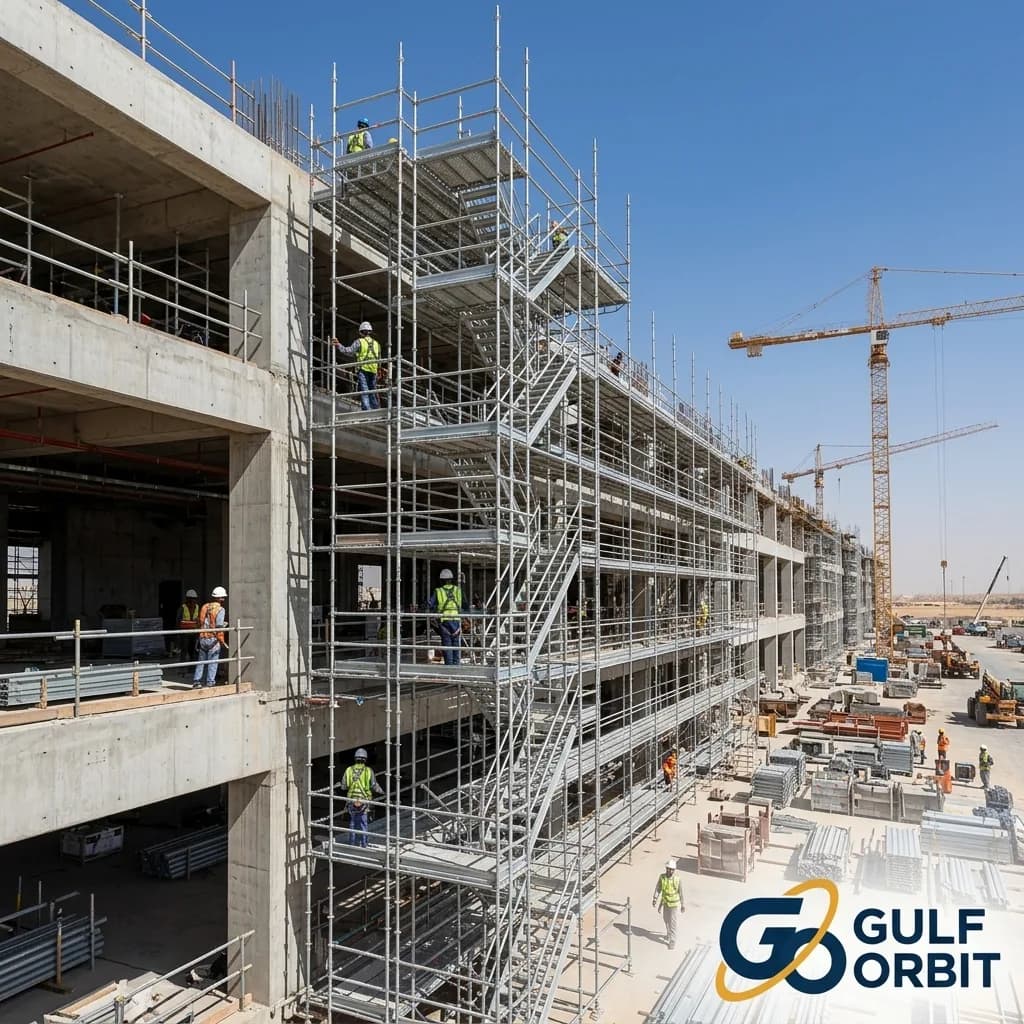
Construction contractors can request Gulf Orbit support for scaffolders, helpers, temporary access, erection, dismantling, and labour around access work, sequenced with the building's facade, MEP, and finishing stages.
Key takeaways
- Scaffolding planned by construction stage causes far less rework than scaffolding planned around the building's overall footprint.
- Facade scaffolding has to be coordinated with tower crane lift paths and swing radius, not treated as an independent structure.
- Wind loading is a real design factor for tall or exposed scaffolding, not just a weather inconvenience.
- Helpers and labour support improve material flow and housekeeping most when the scaffolding crew is covering multiple work fronts at once.
Scaffolding in construction sequencing
Building and infrastructure work generally needs access before facade, MEP, finishing, inspection, and maintenance tasks can continue. Scaffolding planned around the actual construction sequence, which floors or elevations need access when, causes far less rework than scaffolding planned around the site's overall footprint and adjusted reactively as trades arrive.
Coordinating with tower cranes and lift plans
On multi-storey builds, facade scaffolding has to be planned alongside the tower crane's position, lift paths, and swing radius: a scaffold erected without checking this can end up blocking a lift path or requiring costly rework once the crane schedule is finalized. Sharing the site's crane and lift plan with the scaffolding request, where one exists, avoids this conflict before material goes up.
Wind loading on tall or exposed structures
Scaffolding on taller buildings or exposed elevations has to account for wind loading as a real structural factor, not just a scheduling inconvenience during a windy day. This affects bracing, tie-in frequency to the building structure, and sometimes the system type used. Sites in areas prone to strong seasonal winds should flag this in the request so the structure is designed for it rather than reinforced after the fact.
How Gulf Orbit helps contractors
Gulf Orbit can review requests for scaffolders, helpers, lead men, supervisors, rental, erection, dismantling, and labour support around scaffolding work fronts, scoped to the specific construction stage and elevation the contractor needs covered.
Best request details for contractors
Contractors should send the city, project type, number of scaffolders and helpers, duration, start date, working hours, access height, whether the crane or lift plan affects placement, and whether dismantling or mid-project modification support is expected.
Where labour support fits
General labour helps most with material movement, area preparation, cleaning, and trade assistance when the scaffolding crew is covering multiple work fronts simultaneously: a common situation on multi-elevation builds where different floors are at different construction stages at the same time.
Building contractors in the capital can start from scaffolding company in Riyadh; other cities are listed on the scaffolding overview.
Frequently asked questions
Can contractors request scaffolders and helpers together?
Yes. Gulf Orbit can review combined requests for scaffolders, helpers, lead men, supervisors, and related labour support, sequenced with the building's construction stage.
Can Gulf Orbit support construction outside the Eastern Province?
Yes. Gulf Orbit supplies scaffolders and construction trades to projects anywhere in Saudi Arabia, including Riyadh, Jeddah, Madinah and Yanbu, from its offices in Dammam, Jubail and Al Khobar.
Does the tower crane's lift plan matter for scaffolding placement?
Yes. Facade scaffolding needs to be coordinated with the crane's position and swing radius. Sharing the site's lift plan with the request helps avoid a conflict discovered after erection.
Does wind loading actually change how a scaffold is built?
On taller or more exposed structures, yes; it can affect bracing and tie-in frequency to the building. Flagging site exposure in the request lets this be planned for upfront.