

Scaffolding Parts Names in English and Arabic
Standards, ledgers, transoms, couplers, base jacks and boards: the names of scaffolding components used on Saudi sites, in English and Arabic, for tube-and-coupler, cuplock and ringlock.
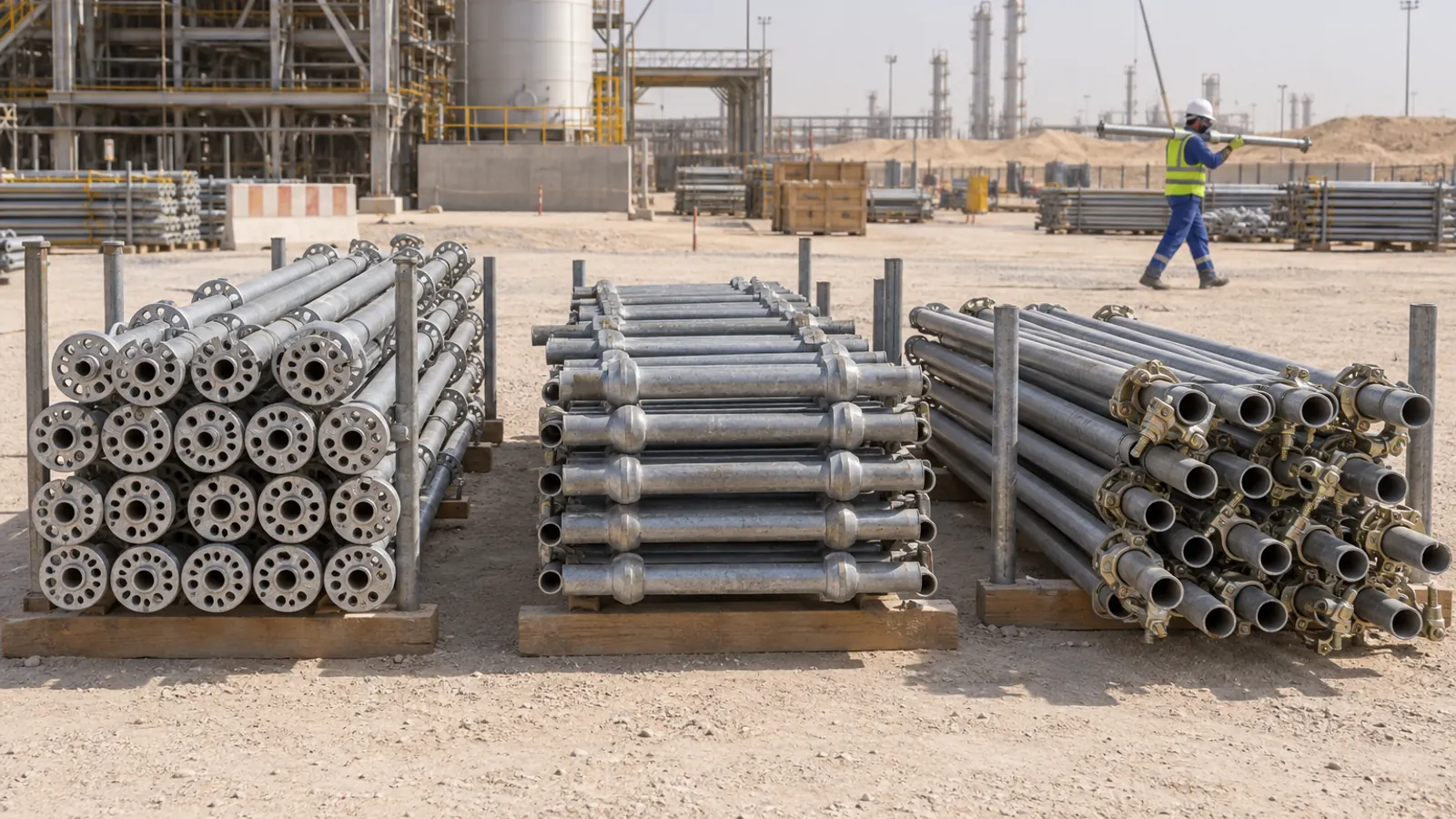
A scaffold is built from standards (vertical tubes), ledgers and transoms (horizontal members), braces, base plates or jacks, and a working platform of boards with guardrails and toe boards. Tube-and-coupler joins these with couplers; cuplock and ringlock use fixed nodes on the standard. The tables below give each part's English and Arabic site name.
Key takeaways
- Standards are vertical, ledgers run along the scaffold, transoms run across it and carry the boards.
- Tube-and-coupler parts are joined by couplers: right-angle, swivel, putlog, sleeve and joint pins.
- Cuplock nodes use a fixed bottom cup and a sliding top cup; ringlock nodes use a rosette and a wedge.
- Use the same names in the RFQ, the delivery note and the rental return, so quantities can be checked line by line.
Why the names matter in a scaffolding order
On many sites scaffolding is still ordered as "pipes and clamps". That works until a rental quotation, a delivery note or a return count lists each item separately, and nobody can match them. Knowing the parts by name, in both languages your site uses, lets you check a quotation against the scaffold you need, count a delivery before the truck leaves, and agree damaged or missing items at return. The names below are the ones used on Saudi construction and industrial sites; some parts have more than one English name, and both are given.
Parts common to every system
Whatever the system, a scaffold has the same basic members. These are the names you will see on most material lists.
| Part (English) | Arabic site name | What it does |
|---|---|---|
| Standard (upright) | قائم | Vertical member that carries the load to the ground |
| Ledger | عارضة طولية (ليدجر) | Horizontal member along the length of the scaffold, joining standards |
| Transom | عارضة عرضية (ترانزوم) | Horizontal member across the width that supports the boards |
| Brace (façade, ledger or plan brace) | دعامة قطرية | Diagonal member that stops the scaffold racking or swaying |
| Base plate | قاعدة ثابتة | Steel plate under each standard that spreads the load |
| Adjustable base jack (screw jack) | قاعدة قابلة للضبط (جاك) | Threaded base used to level the scaffold on uneven ground |
| Sole board | لوح ارتكاز | Timber under the base plates on soft or finished ground |
| Scaffold board (timber plank) | لوح خشبي | Timber working platform laid on transoms |
| Steel deck (steel plank) | لوح فولاذي (بلانك) | Metal working platform, often hooked onto the ledgers |
| Guardrail and mid-rail | درابزين وحاجز أوسط | Edge protection on the working platform |
| Toe board | لوح حافة | Upstand at platform level that stops tools and material falling |
| Tie | رابط تثبيت | Connection from the scaffold to the building or structure |
| Ladder or stair tower | سلم أو برج سلالم | Access between lifts |
| Scaffold tag | بطاقة السقالة | Inspection status at the access point: usable, restricted or not to be used |
Tube-and-coupler parts
Tube-and-coupler, also called tube-and-fitting or tube-and-clamp, uses plain steel tubes of 48.3 mm outside diameter joined by couplers. It can follow any shape, which is why plants use it around pipework and vessels. The couplers are where most of the names are.
| Part (English) | Arabic site name | Use |
|---|---|---|
| Scaffold tube | أنبوب سقالات | Standards, ledgers, transoms and braces, in several lengths |
| Right-angle coupler (double coupler) | وصلة قائمة (مزدوجة) | Joins two tubes at 90°; the main load-bearing coupler |
| Swivel coupler | وصلة دوّارة | Joins two tubes at any angle, mostly for braces |
| Putlog coupler (single coupler) | وصلة بوتلوج (مفردة) | Fixes a transom or putlog to a ledger |
| Sleeve coupler | وصلة جلبة خارجية | Joins two tubes end to end on the outside |
| Joint pin (spigot pin) | مسمار وصل داخلي | Joins two tubes end to end from the inside |
| Beam clamp (girder coupler) | مشبك جسور | Fixes a tube to a steel beam flange |
| Board retaining coupler | وصلة تثبيت الألواح | Holds boards and toe boards in place |
Cuplock parts
Cuplock is a system scaffold. The standard carries cup nodes at 0.5 m intervals: a bottom cup welded to the tube and a top cup that slides down over the ledger ends and locks them with a hammer blow. One node can take up to four ledgers at once, which makes cuplock fast on façades and regular bays.
| Part (English) | Arabic site name | Use |
|---|---|---|
| Cuplock standard | قائم كب لوك | Vertical with cup nodes every 0.5 m |
| Bottom cup | الكأس السفلي | Fixed cup that receives the ledger blades |
| Top cup | الكأس العلوي | Sliding cup that locks the ledger blades |
| Cuplock ledger | عارضة كب لوك | Horizontal with forged blade ends |
| Intermediate transom | عارضة عرضية وسيطة | Extra support for boards between nodes |
| Spigot (standard connector) | وصلة القائم | Joins one standard on top of another |
| Hop-up bracket | كتيفة جانبية | Extends the platform inwards, for example close to a wall |
Ringlock parts
Ringlock is also a system scaffold, built around a rosette welded to the standard every 0.5 m. The rosette has small holes for right-angle connections and larger ones for angled connections, and each ledger or brace head is locked with a wedge driven through the hole. That flexibility suits industrial structures, tanks and stair towers.
| Part (English) | Arabic site name | Use |
|---|---|---|
| Ringlock standard | قائم رينغ لوك | Vertical with a rosette every 0.5 m |
| Rosette | الوردة (روزيت) | Connection plate for ledgers and braces |
| Wedge head and wedge | الرأس الإسفيني والإسفين | Locks a ledger or brace to the rosette |
| Ringlock ledger | عارضة رينغ لوك | Horizontal member between standards |
| Diagonal brace | دعامة قطرية | Stiffens the bay at an angle through the larger rosette holes |
| Base collar (starter) | طوق القاعدة | First short piece over the base jack that starts the bay |
| Steel plank with hooks | لوح فولاذي بخطافات | Platform that hooks onto the ledgers |
Checking a delivery or a rental return
Count each item against the delivery note before the truck leaves, by the names in the quotation. Set aside tubes that are bent, couplers that are cracked or have damaged threads, boards that are split, and base jacks that will not turn, and record them on the note so they are not charged at return. Scaffold inspection and tagging follow your site's procedure; the names above simply make the paperwork match the material.
Renting scaffolding with the names agreed up front
Gulf Orbit rents steel scaffolding in all three systems above, with or without its own crew to erect, modify and dismantle it, for sites anywhere in Saudi Arabia. The scaffolding rental and erection service lists each component in the quotation. If you only need hands for material you already own, see scaffolders. To price a job, send your RFQ with the drawings or work fronts and the system your site uses.
Frequently asked questions
What is the difference between a ledger and a transom?
A ledger runs along the length of the scaffold and joins the standards; a transom runs across the width and carries the boards. On system scaffolds the names are sometimes used loosely, so check the item code on the list.
What is a standard in scaffolding?
A standard, also called an upright, is the vertical member that carries the scaffold's load down to the base plate or base jack.
Which couplers does tube-and-coupler scaffolding use?
Mainly right-angle (double) couplers for load-bearing joints, swivel couplers for braces, putlog (single) couplers for transoms, and sleeve couplers or joint pins to extend tubes.
What is the difference between a base plate and a base jack?
A base plate is fixed and spreads the load; a base jack is threaded so each standard can be raised or lowered to level the scaffold on uneven ground. Both usually sit on a sole board on soft ground.