

Types of Metal Scaffolding and Their Uses
Steel and aluminium scaffolding, the cuplock, ringlock, tube-and-coupler and frame systems, independent, birdcage, cantilever, suspended and mobile scaffolds, and the six load classes: which type fits which job on a Saudi site.
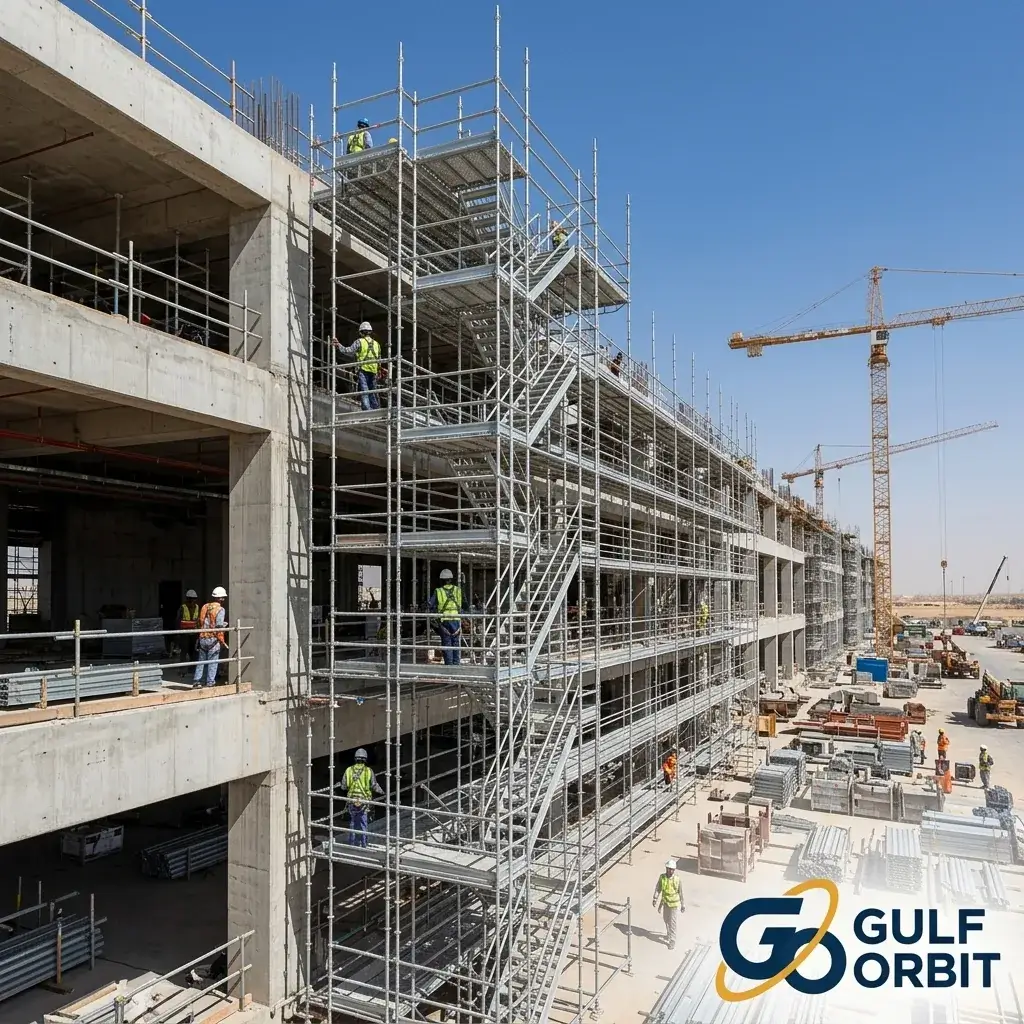
Metal scaffolding is sorted four ways. By material: steel or aluminium. By system: tube and coupler, cuplock, ringlock or prefabricated frames. By structure: independent, single (putlog), birdcage, cantilever, suspended or mobile tower. By load class: six classes in BS EN 12811-1, from 0.75 to 6.00 kN/m². A façade on a tower usually takes an independent cuplock or ringlock scaffold; plant maintenance usually takes tube and coupler; a hall ceiling takes a birdcage.
Key takeaways
- Name the type in four parts in an RFQ: material, system, structure and load class.
- Steel carries heavier loads and suits long hires on construction and plant sites; aluminium is lighter for short moves.
- Modular systems (cuplock, ringlock) are faster on repeating bays; tube and coupler follows any shape.
- The load class sets what the platform may carry; state the heaviest work at each level.
Need scaffolding on your site?
Gulf Orbit supplies manpower and scaffolding to companies across Saudi Arabia. Pick the page closest to your requirement:
Four ways to name a scaffold
"Scaffolding" covers very different structures, and a quotation can only be compared when both sides mean the same one. Name it in four parts: the material it is made of, the system that joins it, the structure it forms, and the load it must carry. The sections below take each in turn.
By material: steel or aluminium
Most construction and industrial scaffolding in Saudi Arabia is galvanized steel, called «سقالات حديد» or «سقالات معدنية» on site. Steel carries heavier loads, stands up to site handling, and suits scaffolds that stay up for months. Aluminium is lighter, so it suits towers that are moved often and indoor work where floors limit the weight. Ask which material is quoted, because the two are not interchangeable on load or price.
By system: how the parts join
The system decides how fast the scaffold goes up and what shapes it can follow.
| System | How it joins | Best for |
|---|---|---|
| Tube and coupler | Loose tubes clamped with right-angle, swivel and sleeve couplers | Plant and refinery work around pipes and equipment; any irregular shape |
| Cuplock | Ledgers locked into cups fixed on the standard, up to four per node | Repeating façade bays, birdcages, shoring and support towers |
| Ringlock | A rosette on the standard takes up to eight connections with wedge pins | Corners, curves, stair towers and heavy access |
| Prefabricated frame | Welded H-frames joined by cross braces | Simple, low access on level ground |
By structure: the shape it forms
OSHA groups scaffolds as supported (standing on the ground or a structure) or suspended (hung from above) (OSHA scaffolding). Within those groups, these are the structures a Saudi site will name.
- Independent scaffold: two rows of standards that stand on their own and are tied to the building; the usual façade scaffold.
- Single (putlog) scaffold: one row of standards, with putlogs resting in the wall; for low-rise masonry.
- Birdcage: a grid of standards across a whole area, for ceilings, halls and the underside of roofs or pipe racks.
- Cantilever: a platform projecting from the structure where the ground below cannot take a scaffold, such as over a street or a lower roof.
- Suspended: a platform hung from the structure above, by tubes and couplers (underhung) or by ropes and hoists (cradles); for work under bridges, racks and on tall façades.
- Mobile tower: a tower on locked castors, moved between work positions on a level floor.
- Shoring or falsework: towers that hold up formwork or a structure during construction; built from the same systems but designed for load, not for access.
By load: the six load classes
BS EN 12811-1 sorts working scaffolds into six load classes by the uniformly distributed load each platform must carry. Your site or design may use its own duty names; the classes give a common reference.
| Class | Uniform load | Typical work |
|---|---|---|
| 1 | 0.75 kN/m² | Inspection and light access, no material stored |
| 2 | 1.50 kN/m² | Painting, cleaning and light finishing |
| 3 | 2.00 kN/m² | General construction and plastering |
| 4 | 3.00 kN/m² | Blockwork and masonry with material on the platform |
| 5 | 4.50 kN/m² | Heavy masonry and stone |
| 6 | 6.00 kN/m² | Heavy-duty special uses |
Which type for which job
These pairings are where most Saudi jobs start. The quotation confirms the system and class for your drawings.
- Tower or hotel façade: independent cuplock or ringlock scaffold, tied to the frame, class 3 or 4 for finishes and blockwork.
- Refinery or plant shutdown: tube and coupler around equipment, with ringlock towers for heavier access.
- Hall ceiling or mosque dome interior: cuplock or ringlock birdcage over the floor area.
- Tank shell: independent scaffold around the tank, or bracket platforms where space is tight.
- Work under a pipe rack or bridge: underhung (suspended) scaffold from tubes and couplers.
- Short indoor tasks on a level floor: a mobile tower.
Metal scaffolding from Gulf Orbit
Gulf Orbit rents steel scaffolding in three systems, cuplock, ringlock and tube and coupler, with or without erection, modification and dismantling, to sites in every Saudi city. Send the structure, the heights and the work at each level, and the system and load class are proposed with the quotation. The scaffolding calculator gives the area or volume to start from, and the parts names guide lists each component. See scaffolding rental in Riyadh or in Jeddah.
Frequently asked questions
What are the main types of metal scaffolding?
By system: tube and coupler, cuplock, ringlock and prefabricated frame. By structure: independent, single (putlog), birdcage, cantilever, suspended and mobile tower. Most Saudi construction and plant work uses steel cuplock, ringlock or tube and coupler.
What are the scaffolding load classes?
BS EN 12811-1 sets six classes by the distributed load on the platform: 0.75, 1.50, 2.00, 3.00, 4.50 and 6.00 kN/m² for classes 1 to 6. Class 1 is for inspection; class 4 suits masonry with material on the platform.
What types of scaffolding does OSHA recognise?
OSHA groups scaffolds as supported scaffolds, which stand on the ground or a structure, and suspended scaffolds, which hang from above. Its rules for both are in 29 CFR 1926.451 and 1926.452.
What is a suspended scaffold?
A platform hung from the structure above instead of standing on the ground. It is built from tubes and couplers (underhung) for work under racks and bridges, or hung on ropes and hoists (a cradle) for tall façades.
Is steel or aluminium scaffolding better?
Steel carries heavier loads and suits scaffolds that stay up for months on construction and plant sites. Aluminium is lighter and suits towers that move often. The job, the load class and the hire period decide.